Oklahoma City, Oklahoma
Oklahoma City Water Quality
Oklahoma City drinks treated lake water from Hefner, Atoka and Draper. The 2025 report lists no violations and a lead 90th percentile of 0 ppb; disinfection byproducts and sodium are the numbers to watch.
Lakes Hefner, Atoka, Draper · no 2025 violations · lead 90th 0 ppb · TTHM RAA 64 ppb (limit 80) · sodium 69.8–176 mg/L.
The short answer
Oklahoma City's tap water is treated surface water from Lake Hefner, Lake Atoka and Lake Draper. The city's 2025 report states there were no violations in 2025, and the lead 90th percentile was 0 ppb.
The results closest to a limit were trihalomethanes, at a highest running annual average of 64 ppb against 80. Sodium ranged up to 176 mg/L.
Get a free test
Tell us your Oklahoma City address. We confirm coverage first, then schedule a licensed technician to test at your tap — no charge, no obligation.
What the 2025 Oklahoma City report shows
Figures below are system-level results from Oklahoma City's Consumer Confidence Report covering 2025. A later report supersedes them.
No violations in 2025
The report states no drinking water violations occurred in calendar year 2025.
Lead 90th percentile: 0 ppb
The 2025 lead 90th percentile was 0 ppb, with results from 0 to 4.41 ppb and no sites over the 15 ppb action level. Copper's 90th percentile was 0.060 ppm against 1.3. Lead at a tap still depends on that home's service line and plumbing; the city keeps a service line inventory you can request at 405-297-3731.
Disinfection byproducts the main number
Total trihalomethanes had a highest running annual average of 64 ppb against an 80 ppb limit, and haloacetic acids 32 ppb against 60. Those are the closest results to a limit in the report.
Sodium up to 176 mg/L
Sodium measured 69.8 to 176 mg/L in September 2025 sampling. There is no federal limit for sodium, but levels in that range matter for anyone on a sodium-restricted diet.
Coliform trigger in May
In May 2025, 1.25% of total coliform samples were positive, which the report lists as a treatment technique trigger requiring follow-up. It is not listed as a violation.
Unregulated monitoring
EPA-required unregulated sampling in 2024 found lithium averaging 40.4 µg/L (up to 67.8) and one PFAS compound, PFPeA, at an average of about 1.4 ppt (up to 4.7). There are no federal limits for either.
Where the water comes from
Three lakes, all surface water.
Lake Hefner
One of three surface-water sources the 2025 report lists for the Oklahoma City system.
Lake Atoka
A second listed surface source. Like the others, it is lake water that is treated before it reaches the city's pipes.
Lake Draper
The third listed surface source. All three are surface water, so the system is not drawing from wells.
Water and power in Oklahoma City
If you are also weighing backup power, our Oklahoma City battery backup page covers OG&E's SmartHours time-of-use rate and how exports are credited. Down the turnpike, Tulsa is served by PSO. To the south, Dallas also runs on all-surface lake and river water, from seven sources.
Where these figures come from
Everything on this page traces to Oklahoma City's Consumer Confidence Report – 2026, covering calendar year 2025 (PWSID OK1020902), as filed with the Oklahoma Department of Environmental Quality.
- Oklahoma DEQ Drinking Water Watch — Oklahoma City CCR (2025 data)
- City of Oklahoma City — Water — the city's Drinking Water Quality Report page.
Matching treatment to the finding
Byproducts and sodium drive most Oklahoma City decisions.
Carbon for byproducts and taste
With TTHMs as the closest result to a limit, point-of-use activated carbon is the usual choice for households that want lower disinfection byproducts and less disinfectant taste.
Reverse osmosis for sodium
Reverse osmosis at the kitchen sink reduces sodium and other dissolved minerals, which is relevant if anyone in the home limits salt.
Hardness: test it
The 2025 report does not list hardness. If scale is building up on fixtures or a water heater, a hardness test at your tap is the way to decide on a softener.
Lead depends on your plumbing
The system's lead results are low, but older homes can still have lead solder or fixtures. Ask the city for your service line record and test if the house predates 1986.
How the free test works
A licensed technician tests at your kitchen tap, walks the plumbing, and tells you which of the findings above applies to your house and which does not. There is no charge and no obligation.
Seamless Home is the licensed contractor of record on the work that follows. Installation is performed by vetted installing partners engaged as our subcontractors, and the workmanship obligation stays with us. Coverage is confirmed per service area rather than promised as blanket availability.
What a water treatment job with us covers
Installation and replacement of whole-home and point-of-use treatment, specified against what your water actually contains.
Sediment filtration
Installation of the first stage that protects everything downstream of it, sized to the service line and the household draw.
Softening
Installation of ion-exchange softening where hardness is the problem, including the drain connection the plumbing code treats as indirect waste.
Carbon filtration
Installation of carbon stages for taste, odour and disinfection by-products, specified from your utility's own water quality report.
Reverse osmosis
Point-of-use installation at the kitchen sink where the target is dissolved solids rather than whole-home flow.
Disinfection
Installation of UV or equivalent treatment where the supply is a private well or is otherwise not continuously disinfected.
System replacement
Replacing equipment that has reached the end of its service life, including the discharge and air gap details an inspector looks at.
This is installation and replacement work, specified from a published water quality report or a test of your supply — not from a sales chart. Coverage is confirmed per service area rather than promised as blanket availability.
What the work actually looks like
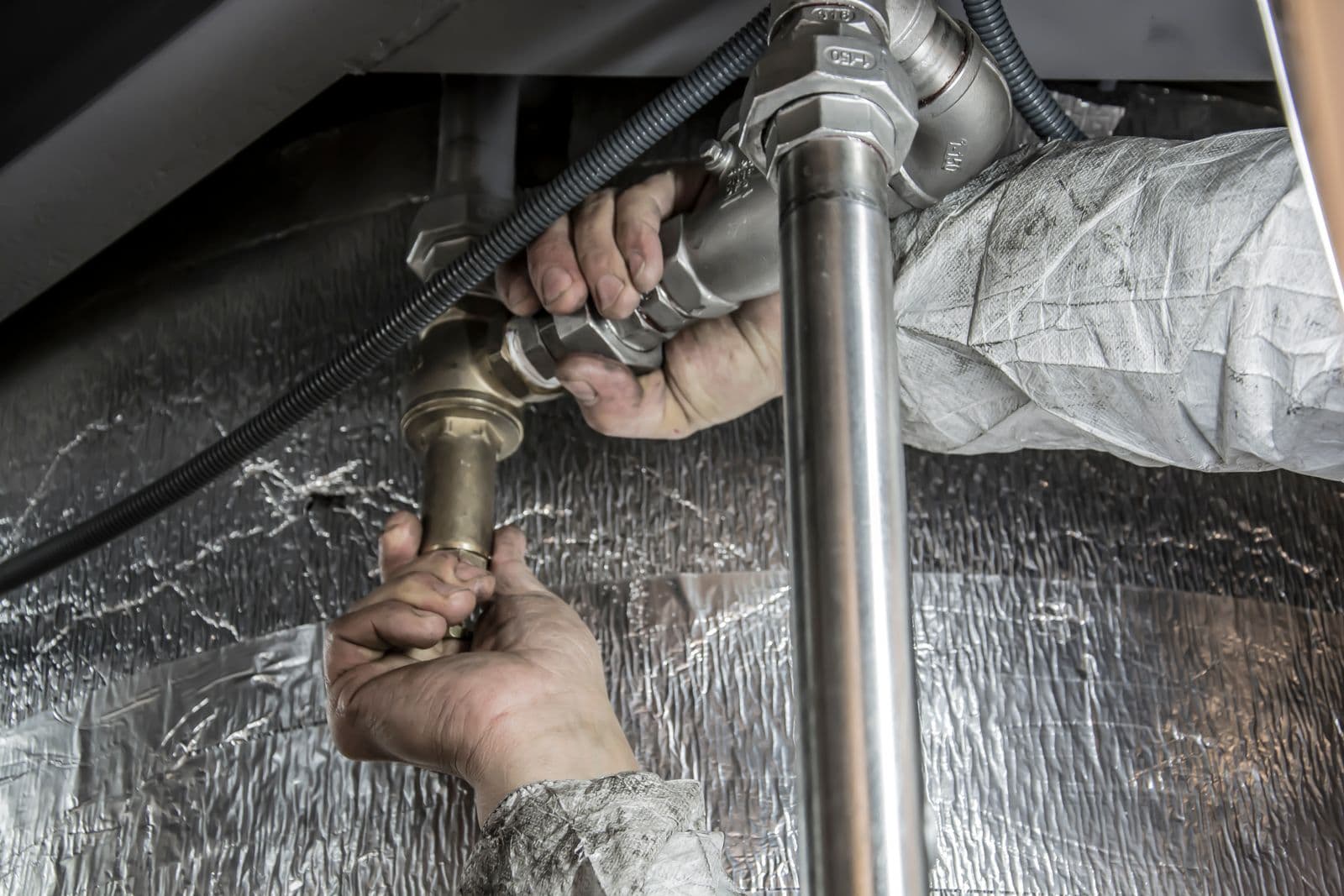
Treatment equipment is plumbing. Most of the job is the connection, the drain and the code detail behind it.


Oklahoma City water, answered plainly
Where does Oklahoma City get its water?+
The 2025 report lists three surface-water sources: Lake Hefner, Lake Atoka and Lake Draper. The water is treated before distribution.
Is Oklahoma City tap water safe to drink?+
The city's 2025 report states that no drinking water violations occurred in 2025. The closest results to a limit were total trihalomethanes, with a highest running annual average of 64 ppb against an 80 ppb limit.
Is there lead in Oklahoma City water?+
The 2025 lead 90th percentile was 0 ppb, with individual results up to 4.41 ppb and no sites over the 15 ppb action level. Lead mainly comes from service lines and home plumbing, so results at one house can differ.
Is Oklahoma City water hard?+
The 2025 report does not list hardness, so we do not quote a number. Total alkalinity was 34 to 47 mg/L. A test at your tap is the reliable way to find out.
Why is the sodium level high?+
The report lists sodium from 69.8 to 176 mg/L but does not give a cause. There is no federal sodium limit; it matters mainly for people on low-sodium diets.
Where do these figures come from?+
From Oklahoma City's Consumer Confidence Report for calendar year 2025 (PWSID OK1020902), as filed with the Oklahoma Department of Environmental Quality. Third-party aggregators are not used.
Related resources
Home water purification and treatment
The national service page behind this one.
Learn more →Oklahoma City battery backup
OG&E SmartHours rates and outage backup.
Learn more →Dallas water quality
Seven surface sources, no groundwater.
Learn more →Tulsa battery backup
PSO territory in northeast Oklahoma.
Learn more →All home services
Water, battery, HVAC and solar under one licensed contractor of record.
Learn more →Get a free test at your tap
A licensed technician tests at your kitchen tap and tells you which Oklahoma City findings apply to your house — disinfection byproducts, sodium, hardness or lead from plumbing. No charge, no obligation, and coverage confirmed at your address first.
Get a free test