Madison, Wisconsin
Madison Water Quality
Madison drinks groundwater from 21 wells. The 2025 report shows low PFAS, a new PFAS filter at Well 15, no known lead service lines — and sodium and chloride rising from road salt.
21 wells · PFAS filter at Well 15 (Sept 2025) · no known lead lines · sodium 2.2–66 ppm by well.
The short answer
Madison's tap water comes from Madison Water Utility, which pumps groundwater from 21 wells in a deep sandstone aquifer. There is no lake or river intake, and most addresses are served by one to three wells.
The 2025 report shows PFOA no higher than 2.0 ppt at any well, a new PFAS removal system at Well 15, and no known lead service lines. The finding to watch is salt: sodium ranged from 2.2 to 66 ppm and chloride up to 200 ppm, depending on the well.
Get a free test
Tell us your Madison address. We confirm coverage first, then schedule a licensed technician to test at your tap — no charge, no obligation.
What the 2025 Madison report shows
Figures below are results from Madison Water Utility's Annual Water Quality Report for testing conducted in 2025. A later report supersedes them.
Your well matters more than the citywide table
The report's table shows the highest and lowest result from any well. Several substances appear at only a few wells, so the utility points customers to its address lookup to see which wells serve a home and that well's own report.
Sodium and chloride are rising
Sodium had a median of 12 ppm but ranged from 2.2 to 66 ppm, and chloride had a median of 32 ppm with a range of 1.0 to 200 ppm. The utility says increases at several wells come mainly from road and sidewalk salt applied over many years.
PFAS at low single-digit ppt
At least one PFAS was found at six wells in 2025. PFOA ranged up to 2.0 ppt (Well 14) and PFOS up to 1.9 ppt (Well 16), both under EPA's 4 ppt MCL. PFHxS ranged up to 6.5 ppt and PFBA up to 49 ppt at some wells.
Solvents at a few east-side wells
Tetrachloroethylene (PCE) was detected up to 2.7 ppb and trichloroethylene (TCE) up to 0.4 ppb at some wells, both under the 5 ppb MCL. The utility lists dry cleaners, auto shops and degreasing sites as typical sources.
Lead: no known lead service lines
As of December 31, 2025, the utility reported no known lead service lines connected to the system, after replacing nearly 8,000 between 1995 and 2011. The most recent tap round (2023) found a lead 90th percentile of 1.8 ppb, with 0 of 50 sites over the action level. The next round is scheduled for 2026.
Very low disinfection byproducts
Total trihalomethanes had a median of 3.7 ppb (range 1.1–8.2) and haloacetic acids 1.3 ppb (range 0.5–2.3), far under the 80 and 60 ppb limits. A groundwater supply with little organic matter produces few byproducts.
How the water is produced
Groundwater pumped from wells, with filters only where a well needs them.
Deep sandstone aquifer — 21 active wells
Madison's water comes entirely from a deep sandstone aquifer hundreds of feet below the city. The system has 21 active wells and more than 920 miles of pipe, and most addresses receive water from one to three wells.
Little treatment at most wells
The utility adds chlorine (typical residual 0.2–0.4 mg/L) and fluoride (2025 system-wide average 0.63 mg/L across 6,602 tests). Four wells have filters that remove more than 95% of iron and manganese.
PFAS removal at Well 15 since September 2025
The report describes the Well 15 PFAS removal system, which went online in September 2025, as a first for a Wisconsin drinking water utility.
Madison next to Milwaukee
Milwaukee treats Lake Michigan surface water, so its report is about a lake intake and lead service lines. Madison's is about individual wells, salt and a handful of PFAS detections — a Milwaukee result does not describe a Madison tap.
Further west, Des Moines treats river water and runs nitrate removal. If you are also thinking about outages, our Milwaukee battery backup page covers We Energies rates and outage history.
Where these figures come from
Everything on this page traces to Madison Water Utility's Annual Water Quality Report, a summary of testing conducted in 2025, issued in May 2026.
Matching treatment to the finding
Salt and well-specific detections drive most Madison decisions; lead service lines do not.
Sodium-restricted diets
If your well sits at the high end of Madison's sodium range, point-of-use reverse osmosis at the kitchen tap is the usual way to cut sodium and chloride for drinking and cooking.
Set the softener correctly
The utility asks households to set water softeners to the correct hardness, because over-salting adds to the chloride problem. A test at your tap tells you the right setting.
PFAS and solvents
Certified carbon or reverse osmosis at the tap reduces PFAS and volatile organics. Whether you need it depends on which wells serve you.
Lead in fixtures, not lines
With no known lead service lines, any lead risk sits in older solder (used until 1986) and fixtures. Flushing after stagnation and a certified lead filter cover it.
How the free test works
A licensed technician tests at your kitchen tap, walks the plumbing, and tells you which of the findings above applies to your house and which does not. There is no charge and no obligation.
Seamless Home is the licensed contractor of record on the work that follows. Installation is performed by vetted installing partners engaged as our subcontractors, and the workmanship obligation stays with us. Coverage is confirmed per service area rather than promised as blanket availability.
What a water treatment job with us covers
Installation and replacement of whole-home and point-of-use treatment, specified against what your water actually contains.
Sediment filtration
Installation of the first stage that protects everything downstream of it, sized to the service line and the household draw.
Softening
Installation of ion-exchange softening where hardness is the problem, including the drain connection the plumbing code treats as indirect waste.
Carbon filtration
Installation of carbon stages for taste, odour and disinfection by-products, specified from your utility's own water quality report.
Reverse osmosis
Point-of-use installation at the kitchen sink where the target is dissolved solids rather than whole-home flow.
Disinfection
Installation of UV or equivalent treatment where the supply is a private well or is otherwise not continuously disinfected.
System replacement
Replacing equipment that has reached the end of its service life, including the discharge and air gap details an inspector looks at.
This is installation and replacement work, specified from a published water quality report or a test of your supply — not from a sales chart. Coverage is confirmed per service area rather than promised as blanket availability.
What the work actually looks like
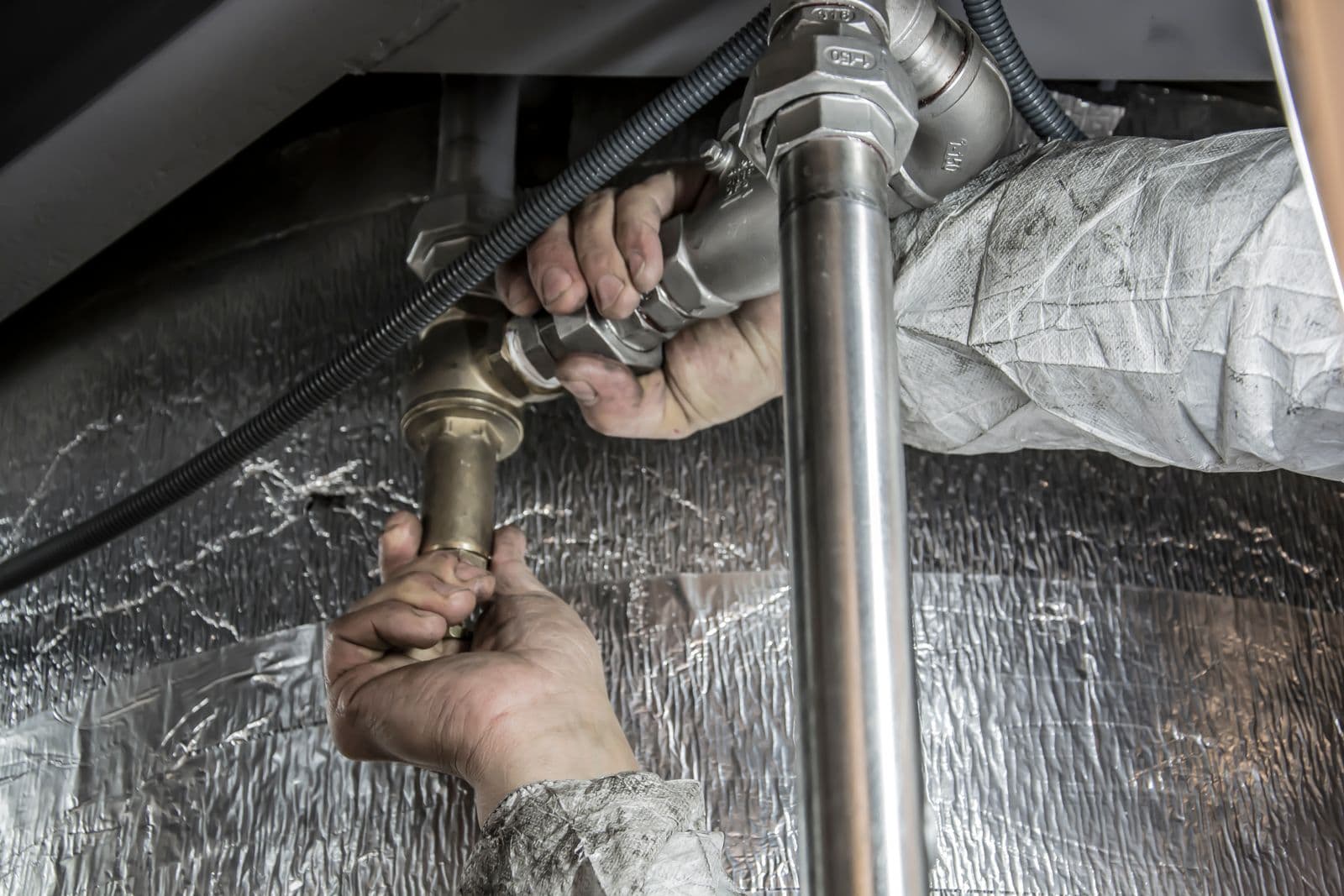
Treatment equipment is plumbing. Most of the job is the connection, the drain and the code detail behind it.


Madison water, answered plainly
Where does Madison, WI get its water?+
From 21 active wells drawing on a deep sandstone aquifer beneath the city. There is no lake or river intake. Most addresses are served by one to three wells.
Does Madison water have PFAS?+
At low levels at some wells. In 2025 at least one PFAS was found at six wells. PFOA was up to 2.0 ppt and PFOS up to 1.9 ppt, both under EPA's 4 ppt limit. A PFAS removal system went online at Well 15 in September 2025.
Are there lead pipes in Madison?+
Madison Water Utility reported no known lead service lines connected to the system as of December 31, 2025. The 2023 tap round found a lead 90th percentile of 1.8 ppb with 0 of 50 sites over the action level. Older homes may still have lead solder or fixtures.
Why is sodium in Madison water going up?+
The utility says historic road and sidewalk salt is the main contributor. In 2025, sodium ranged from 2.2 to 66 ppm and chloride from 1.0 to 200 ppm, depending on the well.
How do I know which well serves my house?+
Madison Water Utility has an online lookup that shows which wells supply an address and links to that well's detailed test results.
Where do these figures come from?+
From Madison Water Utility's Annual Water Quality Report summarizing testing conducted in 2025, issued May 2026. Third-party aggregators are not used.
Related resources
Home water purification and treatment
The national service page behind this one.
Learn more →Milwaukee water quality
Lake Michigan surface water to the east.
Learn more →Des Moines water quality
River water and nitrate removal.
Learn more →Home battery backup in Milwaukee
We Energies rates and outages.
Learn more →All home services
Water, battery, HVAC and solar under one licensed contractor of record.
Learn more →Get a free test at your tap
A licensed technician tests at your kitchen tap and tells you which Madison Water Utility findings apply to your house — sodium, chloride or PFAS from the wells that serve you. No charge, no obligation, and coverage confirmed at your address first.
Get a free test