Leesburg, Virginia
Leesburg, VA Water Quality
All of Leesburg's 2025 water came from the Potomac River. The Town met every standard, with trihalomethanes averaging 68 ppb against an 80 ppb limit.
TTHM avg 68 ppb (limit 80), samples to 96.7 · Hardness 100–150 ppm · UCMR 5: 30 contaminants, none detected.
The short answer
Leesburg treats Potomac River water at the Kenneth B. Rollins Water Filtration Plant. The Town's only well was out of service for all of 2025, so every gallon came from the river. The Town reports that its water was well within all federal and state standards.
The number to know is trihalomethanes: a 2025 average of 68 ppb against an 80 ppb limit, with samples up to 96.7. Haloacetic acids averaged 43 ppb (limit 60). Both are chlorination byproducts, and carbon filtration is the standard way to reduce them at home. Hardness typically runs 100 to 150 ppm.
Get a free test
Tell us your Leesburg address. We confirm coverage first, then schedule a licensed technician to test at your tap — no charge, no obligation.
What filtration does — and does not
Carbon, catalytic carbon and reverse osmosis solve different problems. Leesburg's report points at chlorination byproducts, with moderate hardness.
Where Leesburg water comes from
One river, one plant, Town pipes.
Potomac River
The Town withdraws Potomac River water. VDH's source water assessment rated the Town's river and groundwater sources highly susceptible to contamination, and the Town works with the Potomac DWSPP partnership on it.
Kenneth B. Rollins plant
A coagulant removes particles, multi-media filters remove the rest, and the Town adds sodium hypochlorite, fluoride and orthophosphate to inhibit plumbing corrosion.
Paxton well offline
Leesburg's only groundwater source, the Paxton well, was out of service all of 2025. The Town maintains 250 miles of mains and more than 17,000 service connections.
What the 2025 Leesburg report actually says
Limits are fixed. Results are from the Town of Leesburg Water Quality Report 2025. They are system-level figures, not a reading at your tap.
TTHM averaged 68 ppb (limit 80)
Total trihalomethanes form when chlorine reacts with natural organic matter in river water. The 2025 average was 68 ppb with samples from 22.5 to 96.7 ppb. Compliance is judged on the average, so no violation.
HAA5 averaged 43 ppb (limit 60)
Haloacetic acids, the other main byproduct group, ranged from 15.8 to 50.9 ppb.
Hardness 100–150 ppm
The Town says hardness fluctuates with precipitation but is typically 100 to 150 ppm, or 5.8 to 8.8 grains per gallon.
No PFAS in UCMR 5
Four quarters of EPA UCMR 5 sampling in 2025 covered 30 contaminants and detected none. PFOA and PFOS were each below 4.0 ng/L.
Lead: none of 30 over
2025 tap sampling put lead below 1 ppb (up to 2 ppb) and copper at 0.2 ppm. None of the 30 homes exceeded either action level.
Chlorine 1.4 ppm
The residual averaged 1.4 ppm (0.27 to 2.60) against a 4 ppm limit. Fluoride was 0.67 ppm, nitrate 0.71 ppm and sodium 18 ppm.
Leesburg next to Manassas and Winchester
Manassas uses a reservoir and reports trihalomethanes as its main byproduct, and Winchester draws from the Shenandoah with haloacetic acids closest to their limit. Leesburg's Potomac water puts trihalomethanes in front, and it is one of the few Virginia reports here that publishes a hardness range.
Where these figures come from
Everything on this page traces to the Town of Leesburg.
- Town of Leesburg — Water Quality Report 2025 — source, treatment, hardness, byproducts, UCMR 5 results, lead and copper, and system size.
Matching treatment to the finding
Leesburg's report supports carbon for byproducts. A softener is a choice, not a requirement.
Carbon for byproducts and chlorine
Activated carbon reduces trihalomethanes, haloacetic acids and chlorine taste. A whole-house carbon stage or an under-sink unit certified for those byproducts is the direct answer to this report.
Reverse osmosis at the kitchen tap
For drinking and cooking water with the fewest byproducts, an under-sink RO system with carbon pre-filters covers it.
Softening is optional
At 100 to 150 ppm, some homeowners want a softener for scale on fixtures and water heaters. A tap test tells you where your house sits in that range.
Test at the tap first
Byproduct levels vary by location and season. A test at your kitchen tap shows what reaches your house.
How the free test works
A licensed technician tests at your kitchen tap, walks the plumbing, and tells you which of the findings above applies to your house and which does not. There is no charge and no obligation.
Seamless Home is the licensed contractor of record on the work that follows. Installation is performed by vetted installing partners engaged as our subcontractors, and the workmanship obligation stays with us. Coverage is confirmed per service area rather than promised as blanket availability.
What a water treatment job with us covers
Installation and replacement of whole-home and point-of-use treatment, specified against what your water actually contains.
Sediment filtration
Installation of the first stage that protects everything downstream of it, sized to the service line and the household draw.
Softening
Installation of ion-exchange softening where hardness is the problem, including the drain connection the plumbing code treats as indirect waste.
Carbon filtration
Installation of carbon stages for taste, odour and disinfection by-products, specified from your utility's own water quality report.
Reverse osmosis
Point-of-use installation at the kitchen sink where the target is dissolved solids rather than whole-home flow.
Disinfection
Installation of UV or equivalent treatment where the supply is a private well or is otherwise not continuously disinfected.
System replacement
Replacing equipment that has reached the end of its service life, including the discharge and air gap details an inspector looks at.
This is installation and replacement work, specified from a published water quality report or a test of your supply — not from a sales chart. Coverage is confirmed per service area rather than promised as blanket availability.
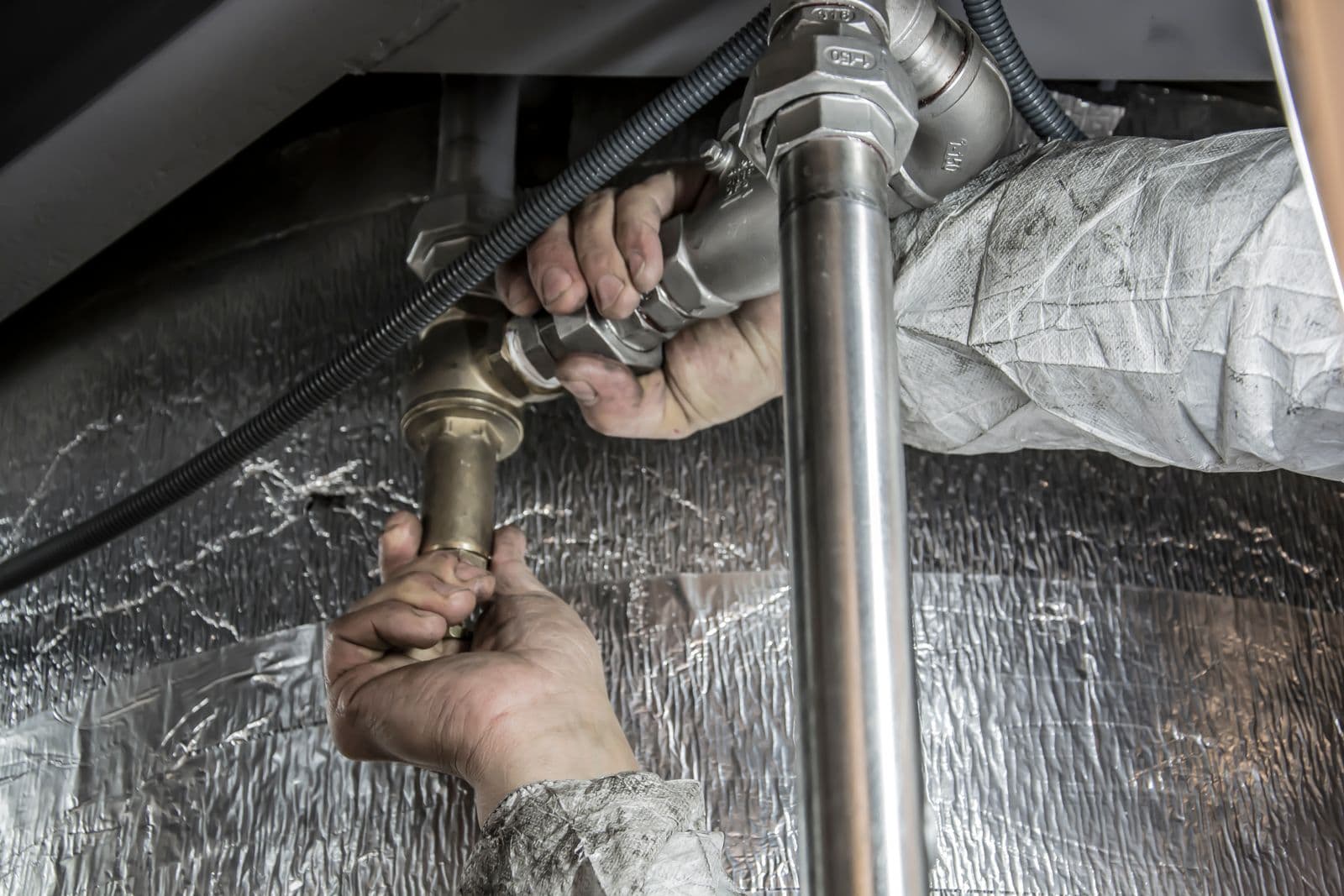
What the work actually looks like
Treatment equipment is plumbing. Most of the job is the connection, the drain and the code detail behind it.

Leesburg water, answered plainly
Where does Leesburg's water come from?+
The Potomac River. In 2025 the Paxton well was out of service, so all water came from the river through the Kenneth B. Rollins Water Filtration Plant.
What are trihalomethanes and why do they matter in Leesburg?+
Trihalomethanes are byproducts of chlorine reacting with natural organic matter. Leesburg's 2025 average was 68 ppb against an 80 ppb limit, with samples up to 96.7 ppb. The system met the standard. Carbon filtration reduces them.
Is Leesburg's water safe to drink?+
The Town reports its water was well within all federal and state standards in 2025, and it received VDH's Excellence in Waterworks award for the 22nd consecutive year.
Is Leesburg's water hard?+
The Town says hardness is typically 100 to 150 ppm (5.8 to 8.8 grains per gallon) and changes with precipitation.
Is there PFAS in Leesburg's water?+
Four quarters of EPA UCMR 5 sampling in 2025 found none of the 30 contaminants tested, including PFOA and PFOS.
Where do these figures come from?+
From the Town of Leesburg Water Quality Report 2025, dated March 2026. Third-party aggregators are not used.
Related resources
Home water purification and treatment
The national service page behind this one.
Learn more →Manassas water quality
Lake Manassas water with trihalomethanes near the limit.
Learn more →Winchester water quality
Shenandoah River water with haloacetic acids near the limit.
Learn more →Alexandria water quality
Another Northern Virginia system.
Learn more →All home services
Water, battery, HVAC and solar under one licensed contractor of record.
Learn more →Get a free test at your tap
A licensed technician tests at your kitchen tap and tells you which findings apply to your house — chlorination byproducts, hardness or your own plumbing. No charge, no obligation, and coverage confirmed at your address first.
Get a free test