El Paso, Texas
El Paso, TX Water Quality
Rio Grande surface water plus two desert aquifers, free chlorine, and a clean lead inventory. Here is what the 2025 Drinking Water Report shows.

Rio Grande + two aquifers · free chlorine avg 1.99 ppm · lead 90th pct 0 ppb · no known lead service lines.
The short answer
El Paso blends Rio Grande surface water with groundwater from the Mesilla Bolson and Hueco Bolson aquifers. Most customers receive a seasonal mix of two sources.
The 2025 report lists free chlorine averaging 1.99 ppm, lead at 0 ppb at the 90th percentile, no identified lead service lines, arsenic averaging 0.0034 ppm under an alternative monitoring plan, and disinfection byproducts under their limits.
Get a free test
Tell us your El Paso address. We confirm coverage first, then schedule a licensed technician to test at your tap — no charge, no obligation.
What filtration does — and does not
Carbon, catalytic carbon and reverse osmosis solve different problems. Match the system to what El Paso's report actually shows.
Where El Paso water comes from
One river, two aquifers, and a seasonal blend for most homes.
Rio Grande surface water
The 2025 report names the Rio Grande as the surface source. El Paso Water says it treats surface water to 0.1 NTU after filtration, tighter than the 0.3 NTU federal requirement.
Mesilla Bolson aquifer
One of two groundwater basins. Most customers receive a blend of surface and groundwater that shifts with the season.
Hueco Bolson aquifer
The second groundwater basin. Some customers receive water from only one source; most receive two.
What the 2025 El Paso report actually says
Limits are fixed. Results are system figures from the El Paso Water 2025 Drinking Water Report, not a reading at your tap.
Free chlorine averaging 1.99 ppm
Unlike Dallas and Fort Worth, El Paso reports free chlorine residual — average 1.99 ppm in 2025 (range 1.10–2.60) against a 4 ppm MRDL.
Lead 0 ppb at the 90th percentile
Lead tap samples in 2025 ranged under 1 to 12.9 ppb, with a 90th percentile of 0 ppb. Copper was 0.472 ppm at the 90th percentile.
No lead service lines identified
More than 100,000 service meters have been assessed. No lead service lines have been identified; 192 galvanized lines require replacement.
Arsenic under an alternative plan
Arsenic averaged 0.0034 ppm in 2025 (individual samples up to 0.0130 ppm) under TCEQ's Arsenic Alternative Monitoring Plan. The average is under the 0.010 ppm MCL.
Disinfection byproducts
TTHM highest locational running annual average was 51.03 ppb (limit 80). Haloacetic acids were 19.23 ppb (limit 60). One individual TTHM sample reached 104 ppb; compliance uses the LRAA.
Fluoride and nitrate
Fluoride averaged 0.58 ppm (0.03–1.08, limit 4). Nitrate as nitrogen averaged 0.74 ppm (under 0.05–2.50, limit 10).
El Paso next to Dallas and San Antonio
Dallas and Fort Worth are all-surface Trinity-basin systems that finish with chloramine. El Paso is a desert blend of river and aquifer water finished with free chlorine.
San Antonio is closer in spirit — mostly groundwater with free chlorine — but it does not share El Paso's Rio Grande surface component or the arsenic alternative monitoring note in the 2025 table.
Where these figures come from
Everything on this page traces to El Paso Water's 2025 Drinking Water Report.
Matching treatment to the finding
El Paso uses free chlorine, so standard carbon usually fits taste-and-odor complaints; softening needs a tap hardness test.
Standard carbon for free chlorine
El Paso uses free chlorine, not chloramine. Standard activated carbon handles free chlorine taste and smell.
Test hardness at your tap
The 2025 chemical tables do not publish a hardness figure we can cite, so a tap test decides whether a softener fits.
RO if you want a drinking-water stage
Under-sink reverse osmosis can reduce dissolved solids and arsenic at a single tap. System-average arsenic is under the MCL.
Check your meter on the inventory map
El Paso Water publishes service-line status by address. Galvanized-requiring-replacement lines are the ones flagged so far.
How the free test works
A licensed technician tests at your kitchen tap, walks the plumbing, and tells you which of the findings above applies to your house and which does not. There is no charge and no obligation.
Seamless Home is the licensed contractor of record on the work that follows. Installation is performed by vetted installing partners engaged as our subcontractors, and the workmanship obligation stays with us. Coverage is confirmed per service area rather than promised as blanket availability.
What a water treatment job with us covers
Installation and replacement of whole-home and point-of-use treatment, specified against what your water actually contains.
Sediment filtration
Installation of the first stage that protects everything downstream of it, sized to the service line and the household draw.
Softening
Installation of ion-exchange softening where hardness is the problem, including the drain connection the plumbing code treats as indirect waste.
Carbon filtration
Installation of carbon stages for taste, odour and disinfection by-products, specified from your utility's own water quality report.
Reverse osmosis
Point-of-use installation at the kitchen sink where the target is dissolved solids rather than whole-home flow.
Disinfection
Installation of UV or equivalent treatment where the supply is a private well or is otherwise not continuously disinfected.
System replacement
Replacing equipment that has reached the end of its service life, including the discharge and air gap details an inspector looks at.
This is installation and replacement work, specified from a published water quality report or a test of your supply — not from a sales chart. Coverage is confirmed per service area rather than promised as blanket availability.
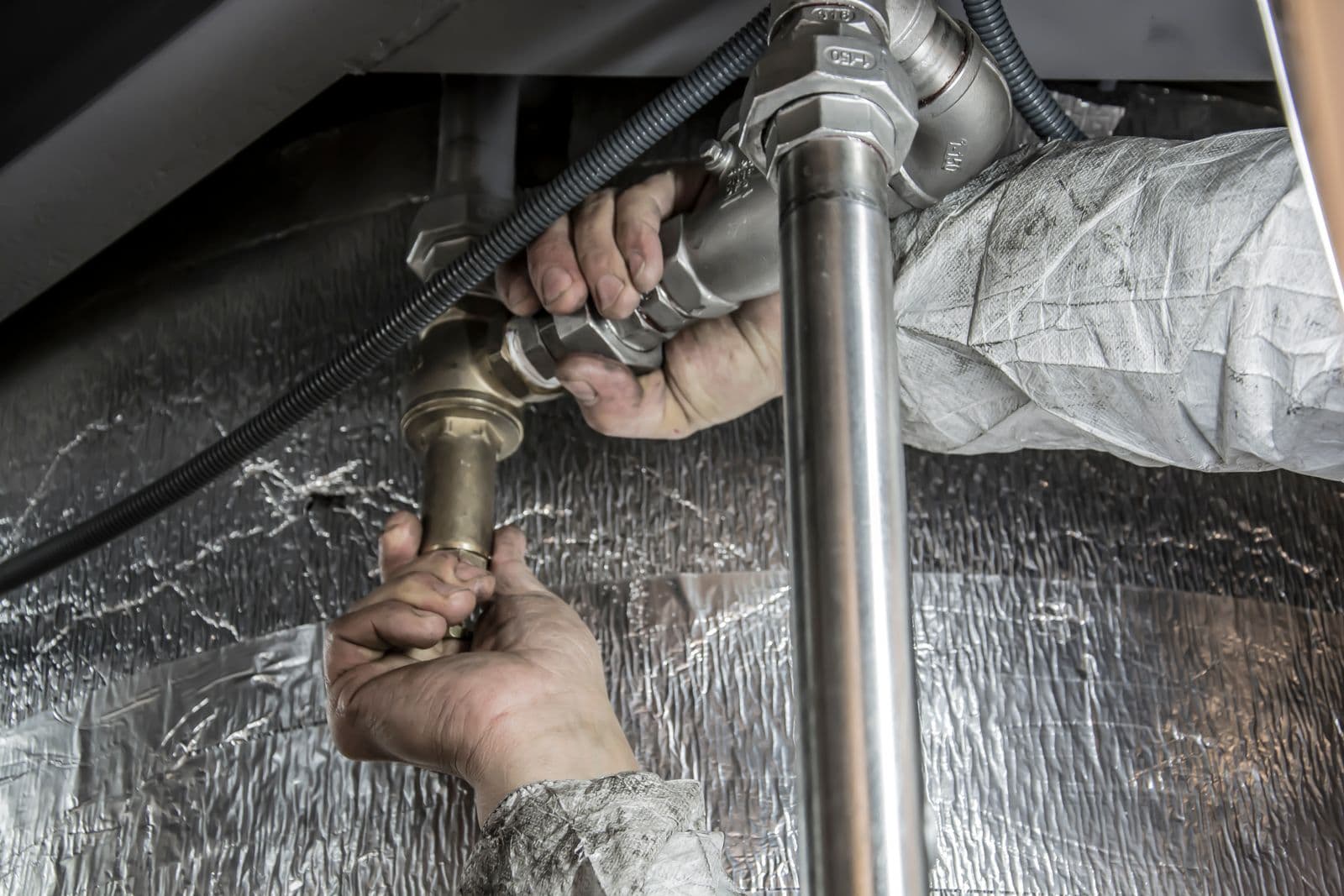
What the work actually looks like
Treatment equipment is plumbing. Most of the job is the connection, the drain and the code detail behind it.


El Paso water, answered plainly
Where does El Paso get its water?+
From three sources: the Rio Grande (surface) and the Mesilla Bolson and Hueco Bolson aquifers (groundwater). Most customers receive a seasonal blend of two sources.
Does El Paso use chlorine or chloramine?+
Free chlorine. The 2025 report lists chlorine residual averaging 1.99 ppm (1.10–2.60 ppm), not chloramine.
Does El Paso have lead service lines?+
The 2025 report says more than 100,000 meters have been assessed, no lead service lines have been identified, and 192 galvanized lines require replacement.
Is there arsenic in El Paso water?+
Arsenic averaged 0.0034 ppm in 2025 under an approved alternative monitoring plan. That average is under the 0.010 ppm federal limit; the report lists no violation.
Is El Paso tap water within federal limits?+
The 2025 Drinking Water Report lists no violations for the regulated results it presents. Your own tap can still differ because of the plumbing in your house.
Where do these figures come from?+
From the El Paso Water 2025 Drinking Water Report PDF on epwater.org. Third-party aggregators are not used.
Related resources
Home water purification and treatment
The national service page behind this one.
Learn more →Fort Worth water quality
TRWD lakes, monochloramine and published hardness.
Learn more →Dallas water quality
Seven surface sources and chloramine.
Learn more →San Antonio water quality
Mostly aquifer water with free chlorine.
Learn more →All home services
Water, battery, HVAC and solar under one licensed contractor of record.
Learn more →Get a free test at your tap
A licensed technician tests at your kitchen tap and tells you which findings apply to your house — chloramine, hardness or your own plumbing. No charge, no obligation, and coverage confirmed at your address first.
Get a free test