Brookline, Massachusetts
Brookline Water Quality
MWRA reservoir water through Brookline's own mains. The Town ended 2025 with no identified lead service lines and 29 private-side unknowns — and a copper result above the MWRA-wide figure.
Lead 1.29 ppb · copper 120 ppb · no identified lead service lines · 29 private-side unknowns.
The short answer
Brookline drinks MWRA water, disinfected with chloramine. Lead was 1.29 ppb at the 90th percentile in fall 2025, with none of 20 samples over the 15 ppb action level.
The Town verified every public-side unknown in 2025 and ended the year with no identified lead service lines and 29 private-side unknowns. Copper ran 120 ppb — under the limit but above MWRA's system-wide 96.6 ppb — which points at household plumbing. That is what a tap test is for.
Get a free test
Tell us your Brookline address. We confirm coverage first, then schedule a licensed technician to test at your tap — no charge, no obligation.
What filtration does — and does not
Softening, carbon and reverse osmosis solve different problems. Match the equipment to what a test at your tap actually finds.
Where Brookline water comes from
The same reservoirs as Boston, through Brookline's own pipes.
Quabbin and Wachusett Reservoirs
The Town's letter says MWRA's reservoirs are the sole source of the water distributed in Brookline.
Treated by MWRA before it arrives
MWRA treats the water at the John J. Carroll Water Treatment Plant in Marlborough, adjusting pH and alkalinity to reduce corrosion and disinfecting with monochloramine (2025 average 1.99 ppm).
Then Brookline's own mains
The Town's Water & Sewer Division runs distribution, including an ongoing unidirectional flushing program that scours tuberculation and sediment out of the mains.
What the 2025 Brookline report actually says
Limits are fixed. Results are from MWRA's 2025 Drinking Water Test Results for Brookline, including the Town letter — system-level figures, not a reading at your tap. A later report supersedes them.
Lead — 1.29 ppb at the 90th percentile
September/October 2025: 1.29 ppb at the 90th percentile against the 15 ppb action level, range 0.104–5.58 ppb, no sample over.
Copper — 120 ppb, above the MWRA-wide figure
Brookline's copper 90th percentile was 120 ppb (range 7.32–165 ppb), under the 1,300 ppb action level but above the 96.6 ppb MWRA reported across all communities. Copper comes from household plumbing, not the reservoir.
No identified lead service lines
In 2025 the Town verified every public-side service of unknown material. All were older cement-lined iron, not lead, and most were replaced with copper or cut and capped at the main.
29 private-side unknowns left
At the end of 2025 the inventory showed only 29 private-side services with unknown material. Unknowns are treated as lead-containing until verified; owners were sent letters on November 24, 2025.
465 service connections and 5,200 meters
In 2025 the Town installed, repaired or replaced 465 service pipe connections, repaired 12 service and main leaks, worked on 13 hydrants and replaced about 5,200 water meters.
Coliform — met every month
Brookline and the MWRA lab test 18 samples each week for disinfectant residual and coliform. Brookline met the 5% monthly standard every month of 2025.
Brookline next to Boston, Watertown and Somerville
Boston wraps around Brookline on the same MWRA water, where the service line is still the governing question. Watertown reported a similar 1.6 ppb lead result but still counts about 400 lead goosenecks, and Somerville is working through its remaining lead services. Brookline's letter is about a street side that is essentially done — which leaves the plumbing inside the house.
Where these figures come from
Everything on this page traces to MWRA and the Town of Brookline Department of Public Works.
- MWRA — 2025 Drinking Water Test Results, with the Town of Brookline letter (PDF) — MWRA sources, treatment and system-wide results; Brookline's lead and copper results, service-line inventory status, 2025 system work and coliform compliance.
- Town of Brookline — Water Service Line Inventory — the inventory results referenced in the Town letter.
Matching treatment to the finding
Brookline's report supports a household-plumbing check and a chloramine-aware filter choice — not a default equipment sale.
If you got the November 2025 letter, answer it
The letter went to owners whose private-side pipe material is still unknown. The Town says it will replace a private-side lead line at no cost; contact water@brooklinema.gov or 617-730-2170.
No letter? Look at the house plumbing
With no identified lead service lines, what remains is inside the house — brass fixtures, older solder and copper pipe. Brookline's copper result is the hint; a tap test shows whether it applies to you.
Point-of-use filter for metals
A kitchen-tap filter certified for lead (and, if a test shows it, copper) handles metals picked up from household plumbing without treating the whole house.
Chloramine taste: catalytic carbon or RO
MWRA disinfects with monochloramine. Ordinary carbon handles free chlorine better than chloramine; if taste or odour is the complaint, catalytic carbon or reverse osmosis is the right tool.
How the free test works
A licensed technician tests at your kitchen tap, walks the plumbing, and tells you which of the findings above applies to your house and which does not. There is no charge and no obligation.
Seamless Home is the licensed contractor of record on the work that follows. Installation is performed by vetted installing partners engaged as our subcontractors, and the workmanship obligation stays with us. Coverage is confirmed per service area rather than promised as blanket availability.
What a water treatment job with us covers
Installation and replacement of whole-home and point-of-use treatment, specified against what your water actually contains.
Sediment filtration
Installation of the first stage that protects everything downstream of it, sized to the service line and the household draw.
Softening
Installation of ion-exchange softening where hardness is the problem, including the drain connection the plumbing code treats as indirect waste.
Carbon filtration
Installation of carbon stages for taste, odour and disinfection by-products, specified from your utility's own water quality report.
Reverse osmosis
Point-of-use installation at the kitchen sink where the target is dissolved solids rather than whole-home flow.
Disinfection
Installation of UV or equivalent treatment where the supply is a private well or is otherwise not continuously disinfected.
System replacement
Replacing equipment that has reached the end of its service life, including the discharge and air gap details an inspector looks at.
This is installation and replacement work, specified from a published water quality report or a test of your supply — not from a sales chart. Coverage is confirmed per service area rather than promised as blanket availability.
What the work actually looks like
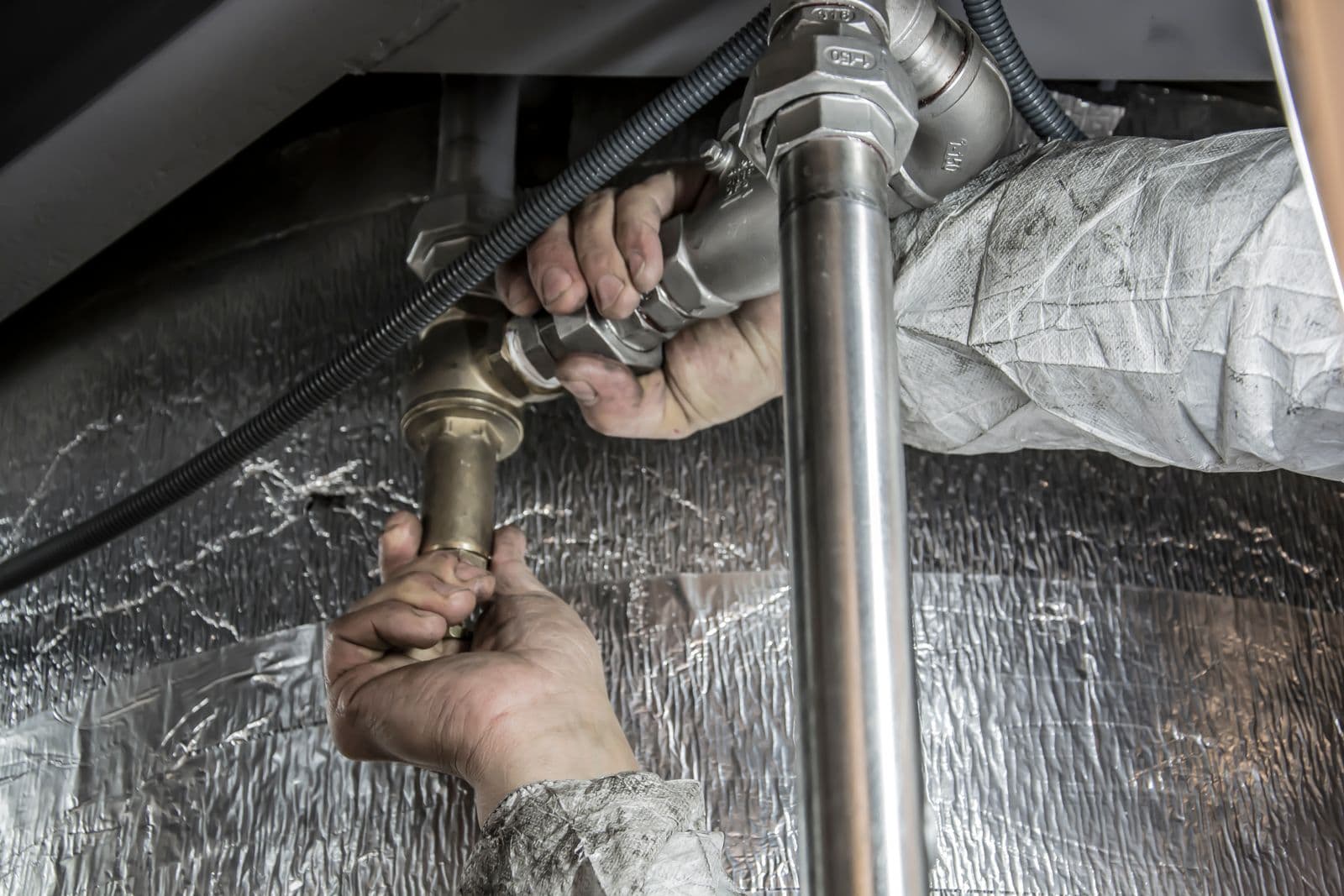
Treatment equipment is plumbing. Most of the job is the connection, the drain and the code detail behind it.


Brookline water, answered plainly
Where does Brookline's water come from?+
From the MWRA. The Town's letter says MWRA's Quabbin and Wachusett reservoirs are the sole source of Brookline's water, which the Town then distributes through its own mains.
Does Brookline still have lead service lines?+
At the end of 2025, the Town's Water Service Line Inventory showed no identified lead service lines and 29 private-side services of unknown material. Every public-side unknown was checked in 2025 and found to be older cement-lined iron.
What if I got a letter about my service line?+
On November 24, 2025 the Town wrote to every customer with an unknown private-side material. If lead is found on the private side, the Town says it will replace it at no cost, with written notice before the work. If you didn't get a letter, your pipe is presumed non-lead.
Why is Brookline's copper higher than other MWRA towns?+
The report doesn't say why. Copper in tap samples comes from household plumbing; Brookline's 120 ppb 90th percentile is under the 1,300 ppb action level but above the MWRA-wide 96.6 ppb.
Does Brookline use chlorine or chloramine?+
Chloramine. MWRA disinfects with monochloramine before the water reaches Brookline.
Where do these figures come from?+
MWRA's 2025 Drinking Water Test Results for Brookline, which includes the Town of Brookline DPW Water & Sewer Division letter (PWS 3046000), and the Town's Water Service Line Inventory page. A later report supersedes these figures.
Related resources
Home water purification and treatment
The national service page behind this one.
Learn more →Boston water quality
The MWRA city wrapped around Brookline.
Learn more →Watertown water quality
Lead 1.6 ppb, with about 400 lead goosenecks still counted.
Learn more →Somerville water quality
MWRA water and a lead replacement program near the finish line.
Learn more →Framingham water quality
MWRA water with no known lead service lines.
Learn more →All home services
Water, battery, HVAC and solar under one licensed contractor of record.
Learn more →Get a free test at your tap
A licensed technician tests at your kitchen tap and tells you which findings apply to your house — metals from household plumbing, chloramine taste or none of them. No charge, no obligation, and coverage confirmed at your address first.
Get a free test