Lexington, Massachusetts
Lexington, MA Water Quality
MWRA reservoir water through 158 miles of Town main. Lexington is in the middle of replacing lead service lines: letters went out in March 2025 and construction began that summer.
Lead 90th 1.79 ppb (0 of 20 over) · lead line replacement since summer 2025 · monochloramine 1.99 ppm.
The short answer
Lexington buys MWRA water from the Quabbin and Wachusett Reservoirs, disinfected with monochloramine. Byproducts and sodium are low, and PFAS is well below the state standard.
The local story is lead service lines. The Town mailed letters to homes with lead, galvanized or unknown lines on March 14, 2025, and replacement construction began in summer 2025. Lead was 1.79 ppb at the 90th percentile, with no home over the action level. If your line is on the list, a lead-certified filter covers the gap until it's replaced.
Get a free test
Tell us your Lexington address. We confirm coverage first, then schedule a licensed technician to test at your tap — no charge, no obligation.
What filtration does — and does not
Carbon, catalytic carbon and reverse osmosis solve different problems. Lexington's letter points at lead from service lines and chloramine taste.
Where Lexington water comes from
MWRA reservoirs, Town pipes.
Quabbin and Wachusett Reservoirs
Lexington is an MWRA member community. Its water starts in the Quabbin Reservoir, passes through the Wachusett Reservoir and reaches town through tunnels and pipes.
Four metered connections
MWRA water enters Lexington at four metered locations. MWRA disinfects it with monochloramine, which averaged 1.99 ppm in 2025.
158 miles of Town main
The Town DPW Water & Sewer division (PWS 3155000) delivers about 5 million gallons a day to 32,271 residents through 13,054 residential and 333 commercial services.
What the 2025 Lexington report actually says
Limits are fixed. Results are from the MWRA 2025 Drinking Water Test Results and the Town of Lexington's letter. They are system-level figures, not a reading at your tap.
Lead lines are being replaced now
The Town sent its service-line inventory to MassDEP in October 2024 and began construction of lead service line replacements in summer 2025.
Letters went out March 14, 2025
Residents with lead, galvanized iron or unknown-material service lines were notified by letter. If you didn't get one and aren't sure, the Town's replacement project page has the contact and inventory map.
Lead 1.79 ppb at the 90th percentile
September/October 2025 samples ranged from 0.075 to 2.25 ppb, with 0 of 20 homes over the 15 ppb action level. Copper was 77.5 ppb at the 90th percentile, none over.
A MassDEP notice on lead result letters
The Town received one Notice of Non-Compliance: homeowners whose taps were sampled got their individual results in 48 days, not the required 30. The Town says it has fixed its process.
Monochloramine, not free chlorine
MWRA's disinfectant averaged 1.99 ppm. It lasts longer in pipes than chlorine and is harder for basic pitcher filters to remove.
Low byproducts, low sodium, PFAS below standard
MWRA reported TTHMs at 16.1 ppb and HAA5 at 15.8 ppb against limits of 80 and 60, a highest sodium of 35.6 mg/L, and PFAS well below the Massachusetts PFAS6 standard of 20 ppt.
Lexington next to Arlington, Waltham and Newton
All four buy the same MWRA water. The difference is in the town pipes. Newton says it has replaced all known lead service lines and is now working on galvanized ones. Waltham and Arlington each report their own local results. Lexington is mid-project, which is why its service-line letter matters more than the reservoir.
The Town's letter also asks residents not to tie sump pumps into the sanitary sewer, and DPW will inspect a setup at no cost. If you're sizing backup power for one, see how many watts a sump pump uses.
Where these figures come from
Everything on this page traces to the MWRA and the Town of Lexington.
- MWRA — Drinking Water Test Results for 2025, with the Town of Lexington letter (published June 2026) — source, lead and copper results, service-line letters, the MassDEP notice, and MWRA-wide results.
- Town of Lexington — Lead Service Line Replacement Project — replacement contacts and the inventory.
Matching treatment to the finding
Lexington's letter supports checking your service line first. It does not support a default equipment sale.
Find out what your service line is
Check the Town's inventory map or your March 2025 letter. A lead or galvanized line is the first thing to settle, before any filter.
A lead-certified filter in the meantime
Until a lead or galvanized line is replaced, a filter certified for lead reduction at the kitchen tap is the practical safeguard.
Catalytic carbon for chloramine taste
Monochloramine is the taste most Lexington homeowners notice. Catalytic carbon, sized for chloramine, handles it better than standard carbon.
Test at the tap first
The Town's figures are system-wide. A test at your kitchen tap shows whether your service line or plumbing is adding anything.
How the free test works
A licensed technician tests at your kitchen tap, walks the plumbing, and tells you which of the findings above applies to your house and which does not. There is no charge and no obligation.
Seamless Home is the licensed contractor of record on the work that follows. Installation is performed by vetted installing partners engaged as our subcontractors, and the workmanship obligation stays with us. Coverage is confirmed per service area rather than promised as blanket availability.
What a water treatment job with us covers
Installation and replacement of whole-home and point-of-use treatment, specified against what your water actually contains.
Sediment filtration
Installation of the first stage that protects everything downstream of it, sized to the service line and the household draw.
Softening
Installation of ion-exchange softening where hardness is the problem, including the drain connection the plumbing code treats as indirect waste.
Carbon filtration
Installation of carbon stages for taste, odour and disinfection by-products, specified from your utility's own water quality report.
Reverse osmosis
Point-of-use installation at the kitchen sink where the target is dissolved solids rather than whole-home flow.
Disinfection
Installation of UV or equivalent treatment where the supply is a private well or is otherwise not continuously disinfected.
System replacement
Replacing equipment that has reached the end of its service life, including the discharge and air gap details an inspector looks at.
This is installation and replacement work, specified from a published water quality report or a test of your supply — not from a sales chart. Coverage is confirmed per service area rather than promised as blanket availability.
What the work actually looks like
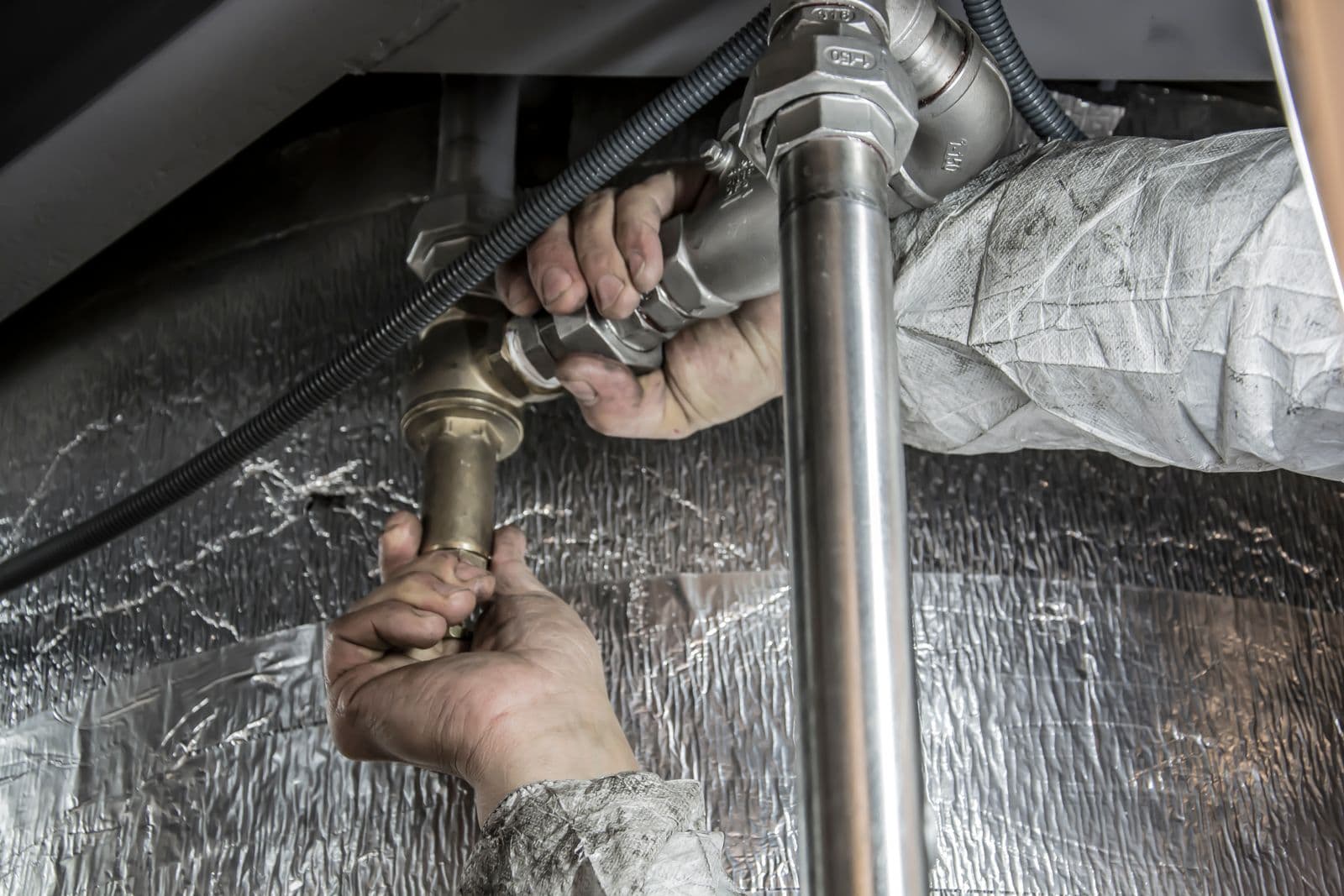
Treatment equipment is plumbing. Most of the job is the connection, the drain and the code detail behind it.


Lexington water, answered plainly
Where does Lexington's water come from?+
Lexington buys its water from the MWRA. It comes from the Quabbin Reservoir through the Wachusett Reservoir and enters town at four metered locations. The Town's DPW distributes it through 158 miles of main.
Does Lexington have lead service lines?+
Some. The Town notified residents with lead, galvanized iron or unknown-material service lines by letter on March 14, 2025, and construction of lead service line replacements began in summer 2025.
What were Lexington's 2025 lead and copper results?+
The September/October 2025 lead 90th percentile was 1.79 ppb (0.075 to 2.25), and copper was 77.5 ppb (11 to 121). None of the 20 homes sampled was over either action level.
What was the MassDEP notice about?+
Lexington received a Notice of Non-Compliance because homeowners whose taps were sampled for lead and copper got their individual results in 48 days instead of the required 30. It was a notification-timing issue, not a water-quality result.
Is there PFAS in Lexington's water?+
MWRA reports trace amounts, well below the Massachusetts PFAS6 standard of 20 parts per trillion.
Where do these figures come from?+
From the MWRA 2025 Drinking Water Test Results with the Town of Lexington's local letter (PWS 3155000), and the Town's lead service line replacement project page. Third-party aggregators are not used.
Related resources
Home water purification and treatment
The national service page behind this one.
Learn more →Newton water quality
All known lead lines replaced; galvanized lines next.
Learn more →Waltham water quality
MWRA water with Waltham's own local results.
Learn more →Arlington, MA water quality
MWRA water with Arlington's own local results.
Learn more →How many watts does a sump pump use?
Sizing backup power for the pump in your basement.
Learn more →All home services
Water, battery, HVAC and solar under one licensed contractor of record.
Learn more →Get a free test at your tap
A licensed technician tests at your kitchen tap and tells you which findings apply to your house — lead from a service line, chloramine taste or your own plumbing. No charge, no obligation, and coverage confirmed at your address first.
Get a free test