How to Sell Solar Without Installing: The Sales-Only Model Explained
By Seamless Home Team, Solar fulfillment operations · July 17, 2026 · Updated August 5, 2026

Quick answer
In the sales-only solar model your organization owns lead generation and the close, then routes the signed deal to partners who handle financing, engineering, permitting, material procurement, installation and project management. You never front working capital for materials and never manage a crew. The trade is dependence: your throughput and your reputation both rest on whether your fulfillment partner reliably builds what you sell, so partner diligence replaces operational overhead as your main risk to manage.
Not every solar company wants to own trucks, hire crews, and carry the cost of materials. A growing number of organizations do one thing extremely well, sell, and hand the rest of the project to a fulfillment partner. This is the sales-only model, and it is how many of the fastest-growing solar businesses operate today. If you are weighing it against owning more of the build, EPC, installer, or sales org compares all three.
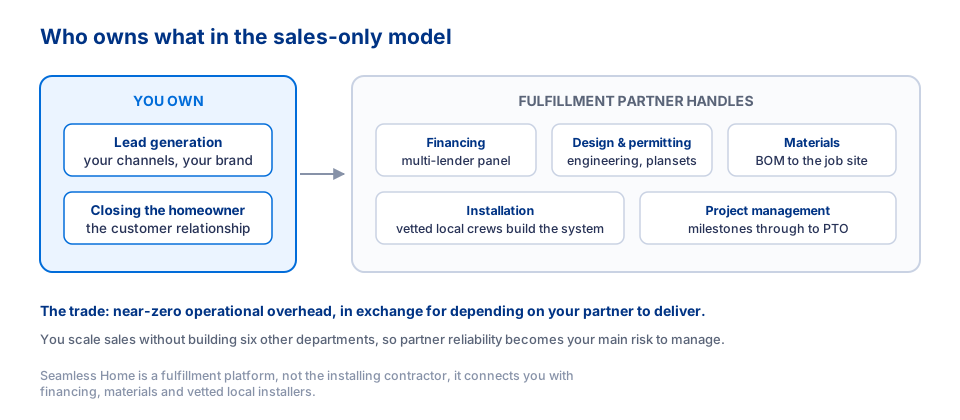
The functions handed off do not disappear; they change from a payroll line into a per-project one, which is the comparison in-house vs outsourced solar operations sets out.
What “sales-only” actually means
In a sales-only model, your organization owns the customer relationship and the close. Once a homeowner signs, the deal is routed to partners who handle financing, engineering, permitting, material procurement, and installation. You never front working capital for panels, and you never manage an install crew, but the project still gets built and you still get paid.
The trade-off is straightforward: you give up direct control over the back office in exchange for near-zero operational overhead and the ability to scale sales without scaling headcount in six other departments.
It is worth being precise about what "near-zero overhead" means, because it is easy to oversell. You still carry the cost of generating leads, the cost of the people who close, and the cost of whatever training and compliance your markets require. What you do not carry is the fixed cost of capability you use intermittently: an engineering team, a permitting desk, a warehouse, crews on payroll between jobs, and a reserve of cash sitting in undelivered panels. Those are the line items that make a solar business hard to scale, and they are the ones this model removes.
What actually happens after the homeowner signs
The single most useful thing a new sales-only operator can internalise is how much happens after the signature, and how little of it is theirs. A signed contract is not a completed project. It is the beginning of a sequence that typically runs eight stages, and you own the first one.
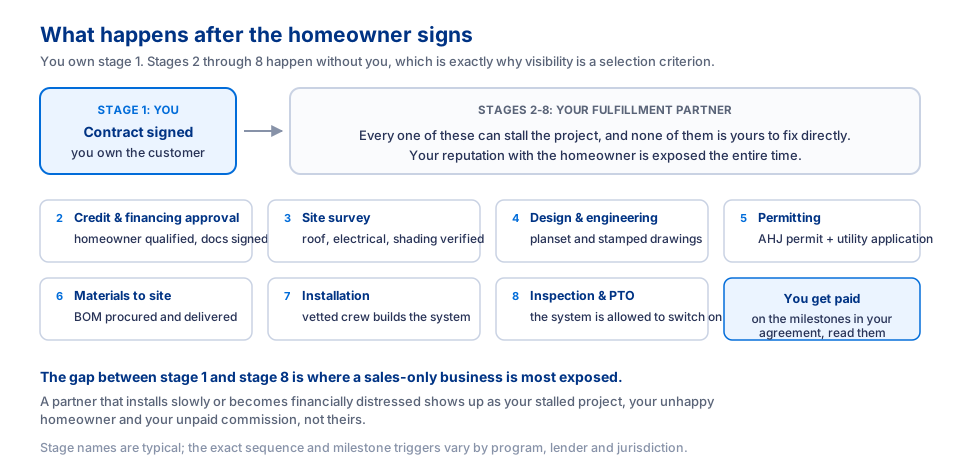
- Contract signed. Yours. Everything after this is someone else's execution and your accountability.
- Credit and financing approval. The homeowner is qualified and the finance documents are executed. A deal can still die here, which is why financing breadth is a close-rate lever rather than a back-office detail.
- Site survey. Roof condition, electrical service and shading are verified against what was sold. Surveys are where optimistic proposals get corrected, and where a change order or a cancellation originates.
- Design and engineering. The system is engineered and a stamped planset is produced. Covered in design and permitting.
- Permitting and utility application. Submitted to the authority having jurisdiction and to the utility. This stage has the widest variance of any in the sequence, and almost none of that variance is under anyone's control.
- Materials to site. The Bill of Materials is procured and delivered. Whoever fronts this cash is carrying the working-capital exposure, see how Direct Pay works for the model that removes it.
- Installation. A crew builds the system. The installer network and its coverage in your specific metros decides how quickly this starts.
- Inspection and permission to operate. Final inspection and utility approval before the system can legally switch on. The PTO and interconnection checklist walks the requirements.
The three things a sales-only org still needs
- Financing that closes: access to multiple lenders (TPO, loan, and sell-on-your-paper options) so a homeowner rarely falls through for lack of a fitting product, see TPO vs loan vs cash for how the structures differ.
- Materials without the cash crunch: a way to get a full Bill of Materials to the job site without fronting the cost before funding lands. Direct Pay is one model for this; the working capital calculator shows what the gap costs you.
- A reliable install handoff: vetted crews that pick up closed-won deals quickly, so projects do not stall between the signature and the install date. That is what an installer network plus active project management is for.
What you give up, stated honestly
Most writing about the sales-only model lists the advantages and stops. The comparison below is the one worth having before you commit, because both columns are real and the right answer depends on which constraint you would rather manage.
| Sales-only | Owning fulfillment | |
|---|---|---|
| Capital at risk | Near zero. You never buy a panel | Material cost per job, once per job in flight |
| Fixed cost | Reps and marketing | Crews, trucks, warehouse, engineering, permitting staff |
| Speed into a new metro | Fast, limited by your partner's coverage there | Slow, you have to hire and license into it |
| Control over install quality | Indirect, through partner selection | Direct |
| Margin per project | Lower, you capture the sales slice | Higher, you capture more of the chain |
| What binds growth first | Partner reliability and coverage | Cash, then crew capacity |
| Failure mode | Your partner stalls and you cannot fix it | You run out of cash while still profitable |
That last row is the honest summary. A sales-only business fails through dependence; an install business fails through liquidity. EPC, installer, or sales org works through the middle ground, and the in-house vs outsourced calculator puts numbers on owning a function versus handing it off.
How you actually get paid
The mechanics here are set by the structure you are selling under, and in most cases that structure is a dealer program — what a solar dealer program is sets out what one includes and how the money moves through it.

Compensation in this model comes from the margin between what the homeowner finances and what it costs to fulfill the project, and it settles on milestones rather than on the signature. That timing gap is the part that surprises people on their first deals: the contract is signed in week one and the money can arrive months later, after permitting, installation and permission to operate.
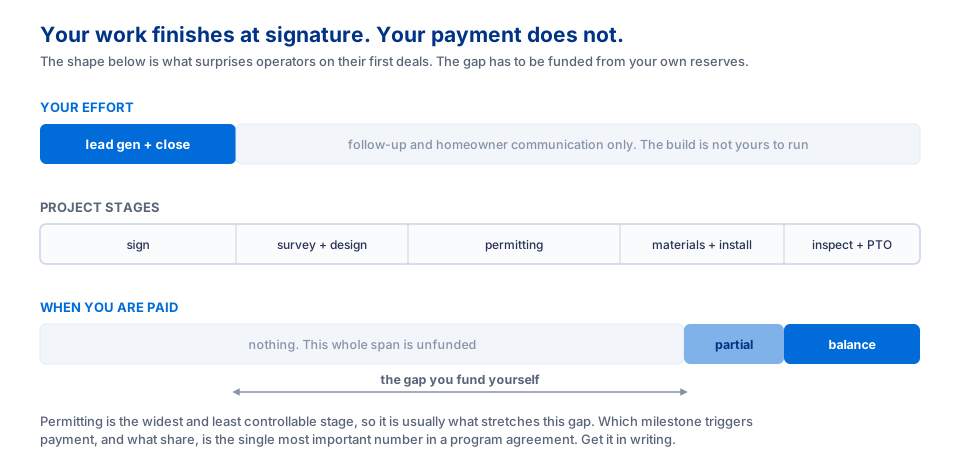
Three details do most of the work in any program agreement, and all three belong in writing before you route volume:
- Which milestone triggers payment, and what share. A split at install and at permission to operate behaves very differently from a single payment at the end. Model your own ramp with the real trigger points rather than assuming payment at signature.
- What happens on a cancellation. Deals die after the survey, after permitting, and occasionally after materials ship. Who carries the cost at each of those points is the question that exposes how the risk is actually allocated. The deal fallout cost calculator quantifies it.
- How the financing structure changes the number. A loan and a third-party-owned deal do not produce the same proceeds on the same system, and a lender's dealer fee comes out of project economics rather than the homeowner's payment. TPO vs loan vs cash explains why, and the TPO vs loan proceeds calculator compares them directly.
Licensing: check, do not infer
Selling solar and installing solar are regulated differently, and the rules vary by state and sometimes by municipality. Some states regulate solar sales directly, others require a contractor licence only for the installation itself, and some require separate registration for the individual salesperson, plus a municipal permit to canvass at all. A licensed contractor has to perform the installation, but that does not have to be your company. Can you sell solar without a contractor licence sets out the three structures that get used and how to tell whether yours is sound.
Where sales-only businesses actually break
Four failure modes account for most of the trouble, and none of them is about closing ability:
- Install coverage that does not match where you sell. A national network is not the same as crews in your metros. This is the single most common mismatch, and the cheapest to check before you sign.
- Going dark at handoff. If you cannot see where a project stands without emailing someone, you will find out about a stalled install from the homeowner. That is a reputational problem before it is an operational one.
- Single-product financing. If your team can present only one structure, every homeowner who does not fit it is a lost deal instead of a deal placed elsewhere.
- Counterparty distress. The one that has done the most damage in this market since 2024. It arrives slowly and then all at once, and by the time it is public your projects are already in it.
Diligence on a fulfillment partner
Because you are trading operational overhead for dependence, partner diligence is the work this model replaces operations with. It is worth treating as a real process rather than a formality:
- Confirm install coverage in your exact metros, not nationally, and ask what current lead time looks like there.
- Ask which lenders you can actually place a deal with, and what happens when a homeowner is declined on the first. The substance of what lender-agnostic means.
- Establish whether materials require upfront capital from you or from the installer, if the installer is capital-constrained, your timelines stretch even though you never touch a pallet.
- Get the payment milestones and cancellation terms in writing, including the case where materials have already shipped.
- Ask what visibility you keep after handoff. A named contact is not the same as being able to see status yourself.
- Check the partner's financial standing before you commit, and again periodically. Our comparison of dealer and fulfillment programs documents current counterparty status for the major programs, with sources: several large residential solar companies have entered bankruptcy since 2024, and one of the most recent was still being recommended on brand recognition well after its filings said otherwise.
Where a fulfillment platform fits
A fulfillment platform is the back end that turns a signed contract into an installed system. Seamless Home connects sales organizations to lenders, delivers discounted materials through Direct Pay with no upfront working capital, matches deals to a network of installers, and manages the project from inception to install. The full sequence is on how it works. To be clear about what that is and is not: Seamless Home is a fulfillment platform, not the installing contractor. It connects you with the financing, materials, and vetted crews that complete the work.
Is the sales-only model right for you?
If your strength is generating and closing homeowner deals, and building an install and operations arm would slow you down, the sales-only model lets you stay in your lane and grow. If you already install and simply want more deal flow or better materials pricing, the same network works from the other side, see solutions for installers and for EPCs.
The model only works when the fulfillment side is dependable. Vet any partner on lender breadth, materials pricing and terms, install coverage in your markets, and how project status is tracked after the sale, what 'turnkey' actually means sets out the ten questions that separate real accountability from coordination. Counterparty stability belongs on that list too, our comparison of dealer and fulfillment programs documents where each one stands. When you are ready to talk specifics, get in touch.
Frequently asked questions
Can you sell solar without being an installer?
Yes. Sales-only organizations close homeowners and route the signed contract to a fulfillment partner that arranges financing, engineering, permitting, materials and installation. This is the premise behind dealer and virtual-EPC programs. You need a licensed contractor to perform the installation, but that does not have to be your company. It can be a partner or a vetted crew in the network you sell through.
What licensing do I need to sell solar without installing?
Requirements vary by state and sometimes by municipality, and they are genuinely different for selling versus installing. Some states regulate solar sales directly, others require a contractor licence only for the installation itself, and some require registration for door-to-door sales. Confirm current requirements with your state licensing board and your own counsel before you sell in a new market. This is not something to infer from how another company operates.
How does a sales-only org get paid?
Compensation depends on the program, but it generally comes from the margin between what the homeowner finances and the cost of fulfilling the project, settled when the project reaches defined milestones. The details, when payment triggers, what happens on a cancellation, how dealer fees affect the number, vary enough between programs that they belong in writing before you commit deal flow.
What is the biggest risk in the sales-only model?
Counterparty risk. Because you do not control fulfillment, a partner that installs slowly, mismanages materials, or becomes financially distressed shows up as your problem: stalled projects, unhappy homeowners, and unpaid commissions. Several large residential solar companies have entered bankruptcy since 2024, so the financial stability of the partner you route deals to is a real selection criterion rather than a formality.
How long does it take to get paid on a sales-only solar deal?
Longer than most people expect on their first deal, because payment is tied to project milestones rather than to the signature. A residential project typically runs through credit approval, site survey, design, permitting, utility application, material delivery, installation, inspection and permission to operate, and permitting timelines alone vary widely between jurisdictions. What matters more than the average is which milestone triggers your payment and how much of it. A program that pays a portion at install and the balance at permission to operate has a very different cash profile from one that pays everything at the end. Get the trigger points in writing before you commit deal flow.
What happens to my deals if my fulfillment partner goes out of business?
This is the scenario worth planning for rather than assuming away, and the 2025-26 residential solar shakeout has made it concrete. Projects in flight are the exposure: deals that are signed but not yet installed can stall, materials already ordered may be tied up, and commissions not yet paid become claims against a distressed company rather than receivables. Practical mitigations are to avoid concentrating all deal flow in one counterparty, to keep your own record of every project's status rather than relying solely on the partner's portal, and to check the partner's financial standing before and during the relationship rather than only at onboarding.
Do I need my own lender relationships to sell solar without installing?
Not usually. Most dealer and fulfillment programs let you sell on the partner's paper, which means the deal is routed through lender relationships the partner already maintains rather than ones you qualify for and manage yourself. That removes a substantial onboarding and compliance burden. The question to ask is not whether you get financing access but how wide it is: a program with a multi-lender panel lets a homeowner declined or priced out on one product still close on another, while a program locked to a single product turns every poor fit into a lost deal.