Your Working-Capital Ceiling: Why Cash, Not Close Rate, Caps Solar Growth
By Seamless Home Team, Solar fulfillment operations · July 20, 2026 · Updated August 5, 2026

Quick answer
Your working-capital ceiling is the number of projects you can run at once before you run out of cash to buy materials. It is your available cash reserve divided by the material cost per job. Because materials are typically paid for weeks before a lender funds the project, every job in flight freezes cash, so a profitable business can still stall at a fixed number of concurrent installs. You can raise the ceiling four ways: hold more cash, shorten the cash cycle, negotiate distributor terms, or move to a procurement model that does not require upfront capital at all.
Ask a growing solar business what limits its volume and you will usually hear about leads or close rate. Look at the balance sheet and the answer is often neither. Materials have to be paid for weeks before the lender funds the project, so every job in flight freezes cash, and once enough jobs are open at the same time, there is nothing left to buy the next set of panels with. The business is not unprofitable. It is illiquid, and illiquidity is a hard ceiling on how many projects can run at once.
This post is about finding that ceiling and moving it. If you want the mechanics of procurement itself, what a Bill of Materials is, who generates it, how delivery is coordinated, that is covered in how Direct Pay works. Here we are doing the arithmetic.
Why cash caps growth before demand does
Profit and liquidity are not the same thing, and solar is a business where they diverge sharply. A residential project can carry a perfectly healthy margin and still consume cash for six to eight weeks. The margin appears on the income statement when the job completes. The cash gap sits on the balance sheet for the entire time the project is open, and it sits there once per concurrent project.
That is what makes it deceptive. Nothing on a per-deal basis looks wrong. Every project is profitable, close rates are holding, the pipeline is full. The constraint only becomes visible when you try to add the eleventh job and discover the reserve is already committed to the first ten.
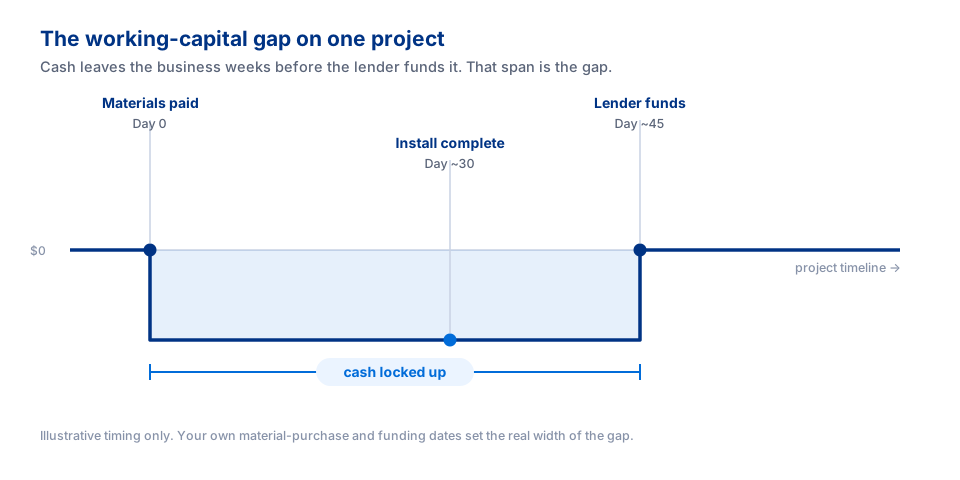
The width of that gap is set by two things you partly control: when your distributor requires payment, and how quickly your lender disburses after the milestones it requires are met. Financing structure matters here: a loan, a cash deal and a third-party-owned system each fund on different triggers and timelines, which is worth understanding in TPO vs loan vs cash and in more depth in how solar financing works. Who pays for what on a solar project maps every outflow that lands inside the gap.
The problem compounds with concurrency
A single project's cash gap is manageable for almost anyone. The trouble is that the gap does not overlap efficiently. It stacks. Ten simultaneous projects mean ten simultaneous material purchases, and the cash committed is the sum, not the average.
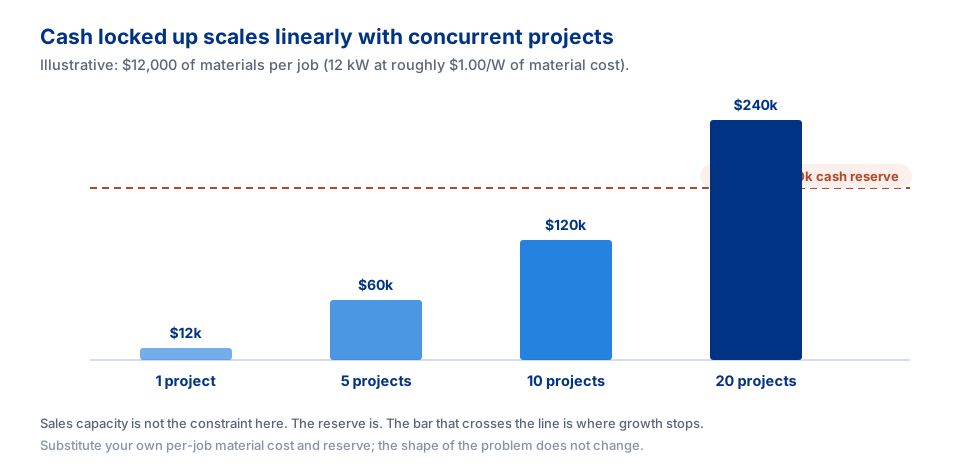
For scale, industry marketplace data puts the average U.S. residential system at roughly 12 kW, with installed costs commonly quoted between about $2.50 and $3.50 per watt in 2026: EnergySage's marketplace average sat near $2.58 to $2.60 per watt in early 2026. Materials are only a portion of that installed cost, with the balance going to labor, design, permitting, overhead and margin. The chart above uses a deliberately round $12,000 of materials per job as a placeholder. Do not adopt that number, substitute your own, because it is the one input that most changes the answer.
Calculate your own ceiling in two lines
You do not need a model for this. Two divisions get you a number accurate enough to plan against.
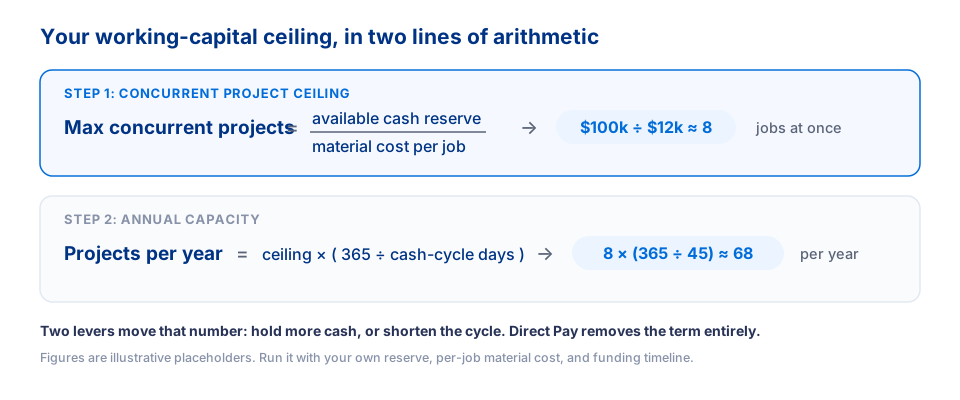
Two things usually surprise people the first time they run it. The first is how low the ceiling is relative to sales capacity. The second is how much leverage sits in the cash-cycle term: cutting the cycle from 45 days to 30 raises annual capacity by half without adding a dollar of cash. That is why delays matter financially and not just operationally. A permitting or inspection hold-up is not only a scheduling problem, it is a direct reduction in how many projects you can run this year. Design and permitting turnaround is a real lever on the cycle, which is part of why it is worth handling deliberately rather than ad hoc; see solar design and permitting and the project timeline tool.
Deals that fall out after materials are committed are the expensive version of the same problem, because the cash is spent and the revenue never arrives. If that happens more than occasionally, the deal fallout cost calculator will put a number on it.
The four ways to raise the ceiling
Every solution to a working-capital constraint is one of four moves. They are not equally good, and the differences are mostly about cost and durability.
| Approach | What it does | Cost | Limit |
|---|---|---|---|
| Hold more cash | Raises the numerator: more reserve, more concurrent jobs | Opportunity cost, dilution, or debt service | Linear. Doubling concurrency means doubling the reserve |
| Shorten the cash cycle | Faster funding and faster installs recycle the same cash more times a year | Operational effort; some of the timeline is not yours to control | Real but bounded, you cannot compress the cycle below your lender's process |
| Negotiate distributor terms | Net-30 or net-60 pushes the payment date closer to the funding date | Usually requires volume and credit history | Narrows the gap rather than closing it; terms can be withdrawn |
| Remove the upfront requirement | Materials procured and delivered without you fronting the cost | Requires a procurement partner | Concurrency is then set by sales and install capacity, not by cash |
The first three all leave the structure intact. You are still financing materials, just more cheaply or for less time. Only the fourth removes the term from the equation. Which one is right depends on your balance sheet and how fast you intend to grow, and the honest answer for many businesses is a combination.
How Direct Pay removes the term entirely
Direct Pay is Seamless Home's material procurement model: discounted material costs with no upfront working capital required. A Bill of Materials is generated from the planset, the materials are procured at program pricing and delivered to the job site, and your organization does not front the cost while waiting for the project to fund. The delivery half of that, sequencing against a real install date and reconciling what arrives against the approved design, is set out in solar materials delivery.
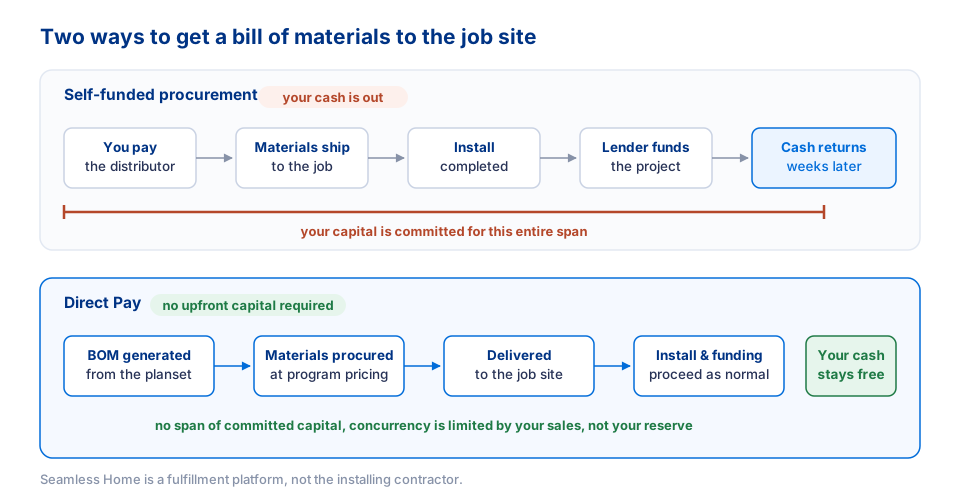
The practical effect is that the ceiling calculation stops governing your growth. Concurrency becomes a function of what you can sell and what your crews can install, which is where most operators would rather have the constraint sit. Full detail on the procurement mechanics is on how Direct Pay works, and the offering itself is on Direct Pay materials.
It lands differently depending on where you sit in the value chain. Installers and EPCs feel it most directly, because they are the ones buying equipment, program pricing plus no upfront cash means the reserve can go to payroll and equipment instead of pallets. Sales organizations feel it at one remove but still feel it: if the crews you route deals to are capital-constrained, your closed deals sit waiting. That is a large part of what a fulfillment platform absorbs, alongside the installer network and project management that keep a deal moving after signature. If you are still deciding which role to occupy, EPC, installer, or sales org walks through the trade-offs.
What to check before relying on any procurement partner
Removing your capital from the materials equation means putting a partner in its place, and that is a counterparty decision. Diligence it accordingly.
- What exactly is fronted, and by whom. Get the terms in writing. "No upfront capital" should mean the BOM is delivered without a payment from you, not a deferral that becomes due before the project funds.
- Coverage in your actual metros. Program pricing is irrelevant if delivery does not reach the markets you sell in. Confirm your specific service areas.
- What happens when a deal falls out. Cancellations after materials ship are the scenario that exposes who carries the risk. Ask before you need the answer.
- BOM accuracy and who owns errors. A BOM generated from the planset should match what the crew needs on site. Ask how discrepancies and returns are handled.
- Visibility after handoff. You should be able to see where materials and the project stand without chasing anyone. Going dark at handoff is a common failure mode.
- Counterparty stability. You are extending operational trust to this partner. In a market where several large residential solar companies have entered bankruptcy since 2024, that is worth checking rather than assuming, see our comparison of dealer and fulfillment programs for how we document counterparty status.
The bottom line
Material pricing gets the attention in procurement conversations, but the payment terms are what actually govern how fast a solar business can grow. A discount improves margin on the jobs you already run. Removing the upfront cash requirement changes how many jobs you can run at all, and for most operators that is the larger number.
Run the arithmetic on your own business first. If your ceiling is meaningfully below your sales capacity, you have found the constraint, and it is a solvable one. The full tool set is free to use, and if you would rather talk it through, get in touch.
Frequently asked questions
What is a working-capital ceiling in solar?
It is the maximum number of projects your business can have in flight at one time before it runs out of cash to buy materials for the next one. Because material costs are usually incurred weeks before the lender disburses funds on a project, each active job ties up cash. Divide your available cash reserve by your material cost per job and you have the ceiling. It is a liquidity limit, not a profitability limit, which is why businesses hit it while still making money on every deal.
Why do solar installers run out of cash while still being profitable?
Profit and liquidity are different things. A job can carry a healthy margin and still consume cash for six to eight weeks between the material purchase and the funding date. Profit shows up on the income statement at completion; the cash gap sits on the balance sheet the entire time the project is open. Run enough jobs at once and the total cash frozen in undelivered materials exceeds the reserve, at which point you cannot start the next project regardless of how profitable it would be.
How do I calculate how much working capital my solar business needs?
Multiply your material cost per job by the number of projects you want to run concurrently, then add a buffer for timing variance in funding. If you want ten concurrent projects at $12,000 of materials each, that is $120,000 committed before any buffer. To go the other direction and find your current ceiling, divide your available reserve by the material cost per job. Our working capital calculator runs both directions with your own numbers.
Does Direct Pay mean I never pay for materials?
No. It means you do not front the cost before the project funds. Direct Pay is a procurement model: the materials are sourced and delivered to the job without requiring upfront working capital from your organization, so the cash is not frozen during the gap. The economics of the project still settle: what changes is the timing, and therefore how many projects you can run simultaneously.
Is this only relevant to installers, or to sales organizations too?
Both, in different ways. Installers and EPCs feel it directly, because they are the ones buying panels, inverters and racking. Sales-only organizations feel it indirectly: if the installers they route deals to are capital-constrained, install timelines stretch and closed deals stall before the build. A sales org that never touches a pallet still has its throughput set by its fulfillment partners' liquidity.
Did the expiry of the 30% federal tax credit change the working-capital picture?
It changed demand and financing mix more than it changed procurement mechanics. The federal Residential Clean Energy Credit under Section 25D applied to property installed through December 31, 2025 and is not available for systems placed in service after that date, which pushed volume toward third-party ownership. The cash gap between buying materials and being funded is structural and did not go away. Confirm current incentive eligibility with a qualified tax professional; Seamless Home does not provide tax advice.