TPO vs Loan vs Cash: How Solar Financing Works for Sales Organizations
By Seamless Home Team, Solar fulfillment operations · July 18, 2026 · Updated August 5, 2026

Quick answer
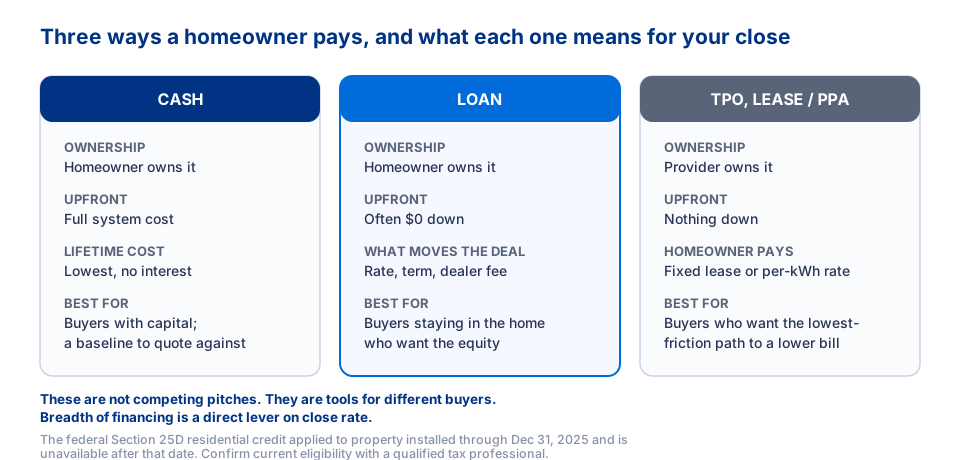
Homeowners pay for solar three ways. With cash they own the system outright at the lowest lifetime cost but need the full amount upfront. With a loan they own it with little or nothing down, and the rate, term and dealer fee decide whether the deal closes. With third-party ownership, a lease or PPA, a provider owns the system and the homeowner pays a fixed monthly amount or a per-kilowatt-hour rate with nothing down and no maintenance obligation. These are not competing pitches but tools for different buyers, which is why access to multiple lenders is one of the most direct levers a sales organization has on close rate.
Most solar deals are won or lost on the financing conversation, not the panels. A homeowner rarely pays cash out of pocket for a system, so the question is almost always how they will pay over time, and the answer you can offer decides whether the deal closes. There are three core paths: cash, a solar loan, and third-party ownership. Here is what each one is and when it fits. For the full mechanics of lenders, approvals and funding, see how solar financing works.
1. Cash
The homeowner pays for the system upfront. It is the simplest structure and usually the lowest lifetime cost because there is no interest or financing fee, and the homeowner captures any state, local, or utility incentives directly. Note that the 30% federal residential tax credit (Section 25D) ended for systems placed in service after December 31, 2025, so it should no longer be quoted to a homeowner buying today. The obvious limit is that few homeowners have the cash on hand, so cash tends to be a small share of residential deals, but it is worth quoting because it gives a clean baseline to compare financed options against.
2. Solar loans
A loan lets the homeowner own the system while spreading the cost over time, typically with little or nothing down. Ownership means they keep the equity and the long-term savings with no lease escalator, which makes loans the most common structure for buyers who plan to stay in the home. Ownership no longer carries a 30% federal residential tax credit, that credit ended for systems placed in service after December 31, 2025, so the ownership case should be made on lifetime savings rather than on a federal credit. The details that move a deal are the rate, the term, and any dealer fee the lender charges to buy down that rate.
- The homeowner owns the system and keeps the full lifetime production and any state or local incentive they qualify for.
- Monthly payment is fixed and predictable, often below the prior utility bill.
- Rate, term length, and dealer fee vary widely by lender, matching the right lender to the buyer matters, which is what the financing type selector is for.
3. Third-party ownership: leases and PPAs
With a lease or power purchase agreement (PPA), a third party owns the system and the homeowner pays either a fixed monthly lease or a per-kilowatt-hour rate for the power it produces. The homeowner puts nothing down and takes on no maintenance responsibility, but they do not own the system, so owner-side credits and incentives flow to the provider rather than to them and are reflected in the rate. TPO is a strong fit for buyers who don't want to own the asset or simply want the lowest-friction path to a lower bill. The ownership split has consequences years later: because the homeowner is hosting rather than owning, adding a battery to a third-party owned system needs the owner's consent.
| Cash | Loan | TPO (lease / PPA) | |
|---|---|---|---|
| Who owns the system | Homeowner | Homeowner | The provider |
| Due at signing | Full amount | Little or nothing | Nothing |
| Homeowner's monthly obligation | None | Fixed loan payment | Lease payment or per-kWh rate, usually with an escalator |
| Who maintains it | Homeowner | Homeowner | The provider |
| Federal residential credit (§25D) | Not available for systems placed in service after Dec 31, 2025 | Not available for systems placed in service after Dec 31, 2025 | Never flowed to the homeowner, entity-level credits sit with the provider and are reflected in the rate |
| Typical close friction | Very high, few homeowners have the cash | Credit qualification, rate and term | Lowest, no cash and no credit-to-own hurdle |
| Who it suits | Buyers with cash who want the lowest lifetime cost | Buyers staying in the home who want equity and lifetime production | Buyers who want a lower bill without owning an asset |
Lease and PPA are not interchangeable, and the difference decides who carries production risk: solar lease vs PPA. For the mechanics of third-party ownership generally, see what TPO means in solar.
The dealer fee, worked through

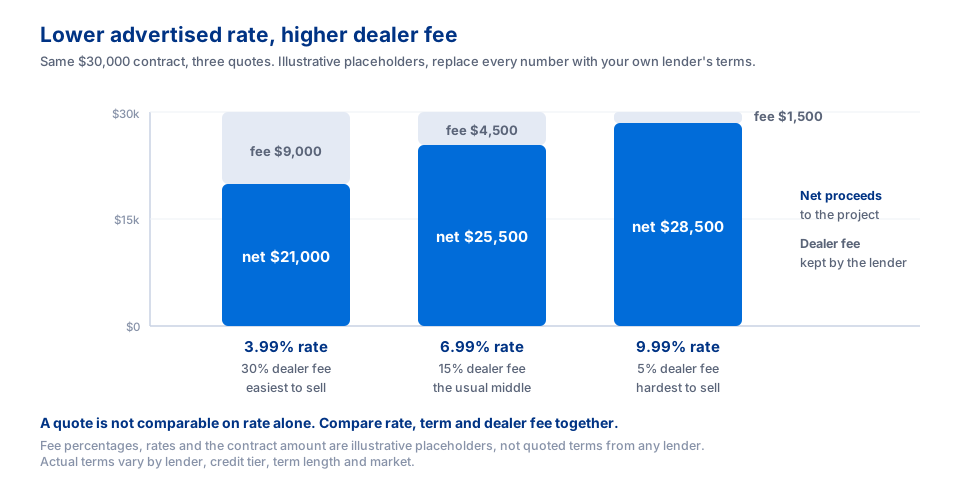
The dealer fee is the piece of loan economics that most often gets misread, because it is invisible in the number the homeowner hears. A dealer fee is an amount the lender deducts from the funded proceeds in exchange for offering the homeowner a below-market interest rate. The homeowner sees a lower rate. The project receives less money. The two move in opposite directions, and they move together, always.
Escalators decide lifetime cost more than the lease-versus-PPA choice does
On third-party ownership, the structural question reps ask most often, lease or PPA?, is usually less consequential than the escalator. A lease charges a fixed monthly amount for use of the equipment. A PPA charges a per-kilowatt-hour rate for the power produced, so the bill moves with production. Both are third-party ownership, and in both the provider owns the asset.
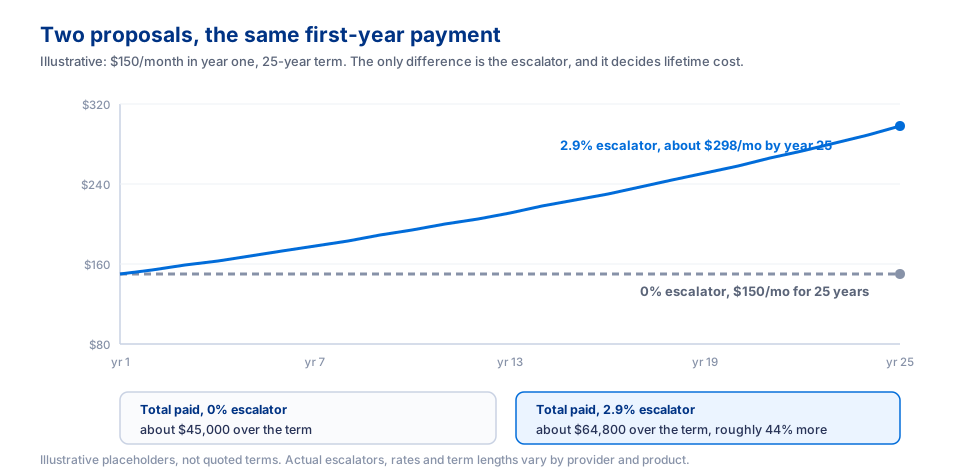
The escalator is the annual contractual increase applied to that payment. A 0% escalator holds the payment flat for the life of the agreement; a low-single-digit escalator raises it every year, compounding across a term that commonly runs twenty years or more. Two proposals with identical first-year payments and different escalators are not the same deal, and a comparison that stops at year one will mislead the homeowner and eventually the rep. Look at the payment in year fifteen.
What changed when the federal residential credit expired
The 30% federal Residential Clean Energy Credit under Section 25D applied to property installed through December 31, 2025 and is not available for property placed in service after that date. For years it was the anchor of the ownership pitch: buy the system, claim 30% back. That lever is gone for homeowners buying today, and quoting it now would be inaccurate.
Two practical consequences follow. First, the ownership case has to be made on equity and lifetime production rather than on a federal credit. A real case, but a slower one to make. Second, business-side credits are a separate matter: in a third-party-owned lease or PPA the provider owns the system and may claim entity-level credits, which is reflected in the rate it offers rather than in anything the homeowner claims. That asymmetry is part of why volume has shifted toward third-party ownership. State, local and utility incentives are unaffected by the federal change and vary widely by jurisdiction.
Matching the structure to the buyer
The strongest close comes from reading the buyer and reaching for the structure that fits, which is only possible if you carry more than one. A rough mapping:
| If the homeowner… | Lead with | Because |
|---|---|---|
| Plans to stay in the home long term and qualifies on credit | Loan | They keep the equity and the full lifetime production with no escalator |
| Wants no upfront cost and no maintenance obligation | Lease or PPA | The provider owns and maintains the asset |
| Does not qualify for the loan products you can offer | Lease or PPA | TPO underwriting is a different question from loan underwriting. A decline on one is not a decline on the other |
| Is likely to move within a few years | Lease or PPA | Transferability is a defined process rather than a sale of an encumbered asset |
| Has the cash and wants the lowest lifetime cost | Cash | No interest, no fee, no escalator, and it gives you a clean baseline to quote the others against |
| Is comparing you against another quote | All three | A single-structure pitch loses to a multi-structure one on flexibility alone |
“Sell on your paper” as a fourth option
Some fulfillment partners also let a sales organization sell on the partner's paper, routing the financed deal through the partner's lender relationships rather than the org setting up and maintaining its own. For a sales-only org, this removes the burden of qualifying, onboarding, and managing multiple lenders directly while still giving homeowners a full menu of products. It is one of the reasons the sales-only model is viable without a financing desk.
Why multi-lender access changes your close rate
No single lender approves every homeowner or wins on every rate. When your team can only offer one financing product, a deal that does not fit that product is a lost deal, which is the practical case for being lender-agnostic rather than tied to one funding source. Access to a multi-lender panel, GoodLeap, LightReach, Sunlight Financial, EnFin, Concert Finance, and Solrite, means a homeowner who is declined or priced out on one path often still closes on another. Breadth of financing is one of the most direct levers on close rate a sales org has, and the deal fallout cost calculator puts a number on what the alternative costs you. For the mechanics underneath all of it — how solar financing works from credit approval through stipulations to milestone funding — start there and come back.
The takeaway
Cash, loan, and TPO are not competing pitches. They are tools for different buyers, and the strongest close comes from matching the structure to the homeowner in front of you. The structure also determines what the deal nets you, which the TPO vs loan proceeds calculator makes concrete. Seamless Home connects sales organizations to multiple funding sources so your team can present the right option on every deal instead of forcing every homeowner into one: alongside Direct Pay materials, an installer network and project management. Seamless Home is a fulfillment platform, not a lender or the installing contractor; it connects you with the financing, materials, and vetted crews behind the project. Get in touch to talk through your mix.
Frequently asked questions
What is the difference between a solar lease and a PPA?
Both are third-party ownership, and in both the provider owns the system. The difference is what the homeowner pays for. Under a lease they pay a fixed monthly amount to use the equipment regardless of how much it produces. Under a power purchase agreement they pay a per-kilowatt-hour rate for the electricity the system actually generates, so the bill moves with production. Escalator terms, whether and how fast that payment rises annually, matter more to lifetime cost than the difference between the two structures.
Is a solar loan or a lease better for the homeowner?
It depends on the buyer, not on the product. Ownership through a loan keeps the equity and the long-term savings and suits someone planning to stay in the home. A lease or PPA removes the maintenance obligation and the upfront cost and suits someone who wants the lowest-friction path to a lower bill or who cannot use ownership benefits. Forcing every homeowner into whichever structure you happen to offer is how deals get lost.
What is a dealer fee on a solar loan?
A dealer fee is an amount the lender deducts from the funded proceeds in exchange for offering the homeowner a below-market interest rate. A lower advertised rate generally means a higher dealer fee, so the two move together and the fee comes out of project economics rather than out of the homeowner's monthly payment. Compare lenders on the combination of rate, term and fee rather than on the headline rate alone.
Is there still a federal tax credit for residential solar?
No. The 30% federal Residential Clean Energy Credit under Section 25D applied to property installed through December 31, 2025 and is not available for systems placed in service after that date. Quoting it to a homeowner buying today would be inaccurate. State, local and utility incentives may still apply and vary widely. Confirm current eligibility with a qualified tax professional; Seamless Home does not provide tax advice.
Why does multi-lender access matter so much?
No single lender approves every homeowner or wins on every rate. If your team can present only one financing product, every homeowner who does not fit that product is a lost deal rather than a deal placed elsewhere. Access to several funding sources means a buyer declined or priced out on one path often still closes on another, which is why financing breadth shows up directly in close rate.
What is an escalator on a solar lease or PPA?
An escalator is a contractual annual increase in what the homeowner pays, commonly expressed as a fixed percentage applied each year for the life of the agreement. A 0% escalator holds the payment flat; a 2.9% escalator raises it every year, which compounds substantially across a twenty-plus-year term. Escalator terms typically move lifetime cost more than the choice between a lease and a PPA does, so a proposal that compares only first-year payments is not a like-for-like comparison. Model the payment in year fifteen, not just year one.
Why does the same system produce different proceeds under a loan and under TPO?
Because the two structures pay the project in different ways. Under a loan the lender funds an amount derived from the contract price, less any dealer fee, once its milestone conditions are met. Under third-party ownership the provider is buying an asset and a contracted revenue stream, so what it pays reflects its own cost of capital, the credit quality of the customer agreement, the escalator, and any credits it can claim at the entity level. The result is that the structure a homeowner chooses changes your economics on an otherwise identical system, which is why it is worth modelling both rather than assuming.
How should a rep decide which structure to present first?
By the homeowner's profile, not by which product is easiest to sell. Someone planning to stay in the home long-term with the credit to qualify and an appetite for ownership is a loan or cash conversation. Someone who wants no upfront cost, no maintenance obligation, and the lowest-friction path to a lower bill is a lease or PPA conversation. Someone whose credit does not qualify for the loan products available may still close on third-party ownership. Presenting a single structure to every homeowner is the most common self-inflicted close-rate problem in residential solar.